
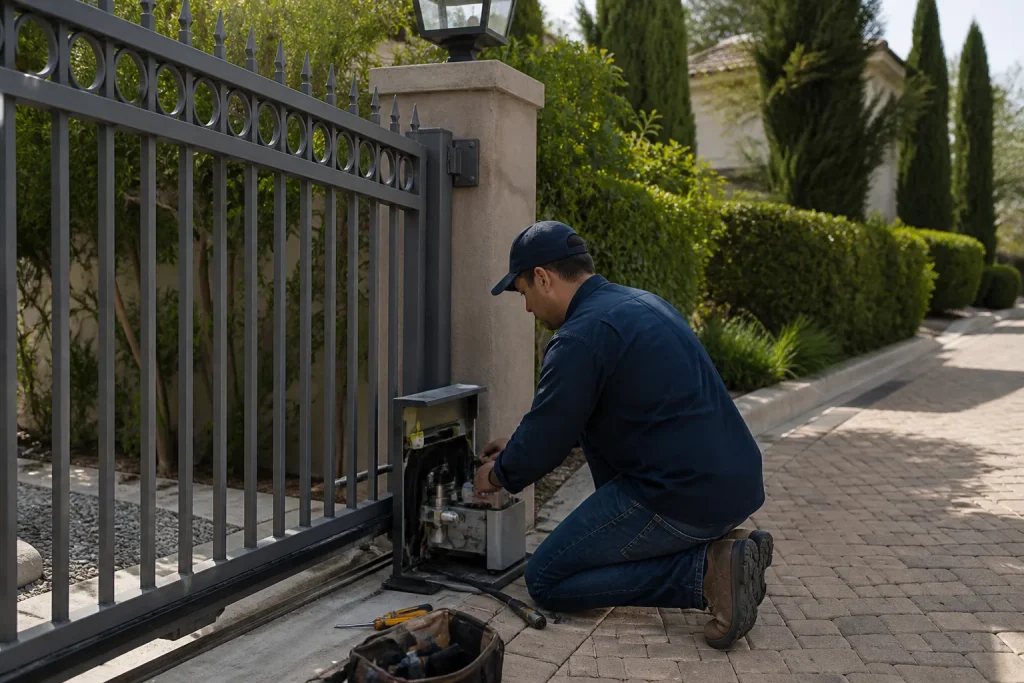
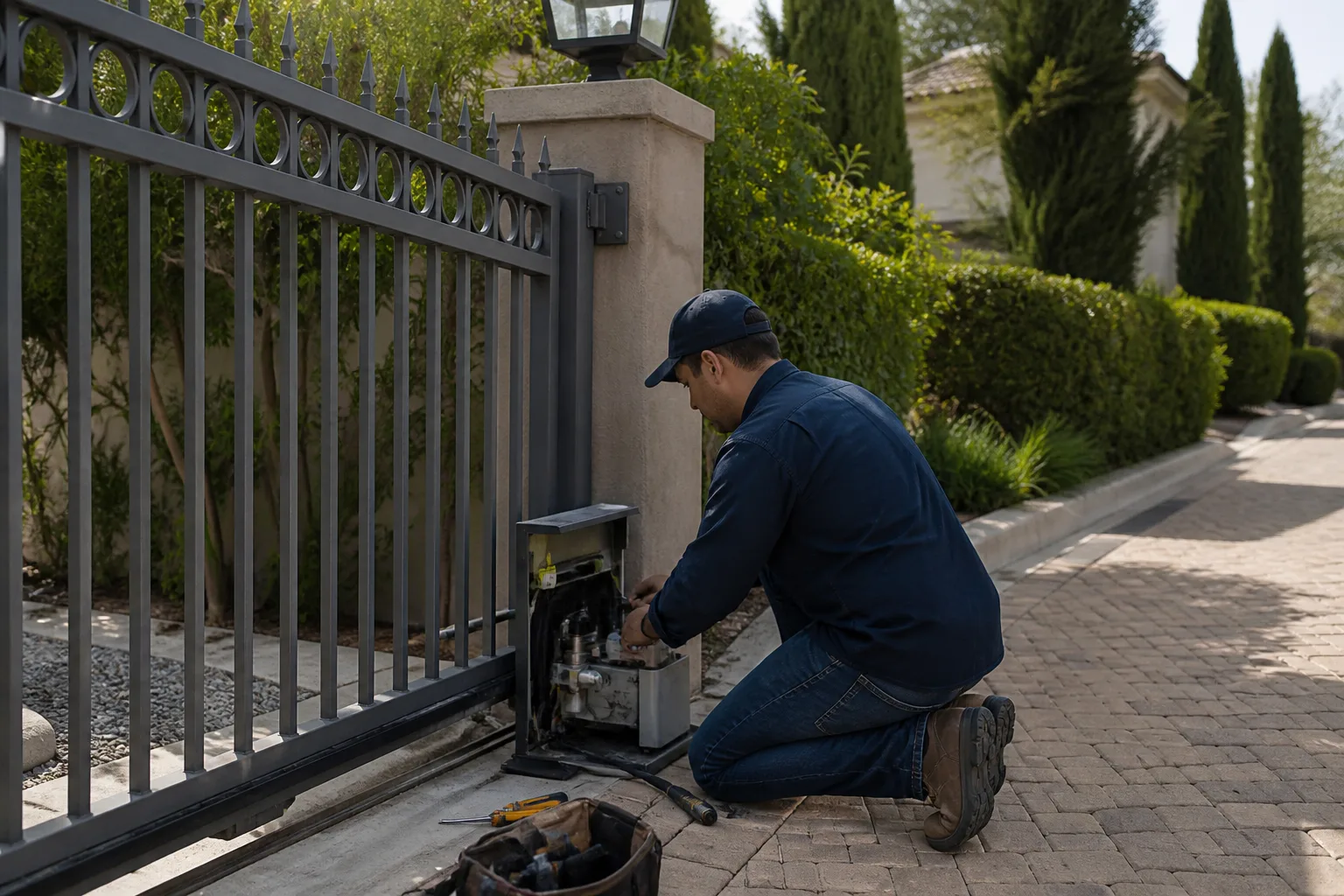
FAAC Gate Repair in Los Angeles: A Homeowner’s Guide
FAAC gate repair in Los Angeles typically costs between $285 and $650 for most common issues, with hydraulic rebuilds running higher if the pump has been running dry. The opener you have is one of the best-built machines on any LA property, but its Italian engineering doesn’t tolerate shortcuts. If you’d rather skip the diagnosis and get a trained technician to your gate, call Calder Gate Repair at (903) 417-0793 for a free estimate.
FAAC openers are so quiet and smooth that most homeowners don’t notice a developing hydraulic leak until the gate stops mid-swing at 7 a.m., by which point the repair cost has already doubled from what it would have been 30 days earlier. That’s the catch with this brand. It’s over-engineered in the best way, which means it hides its problems until they’re expensive. This guide covers what FAAC owners in Los Angeles can safely check themselves, what to leave alone, and when the hard stop is.
What Makes FAAC Different From Every Other Gate Opener
FAAC builds hydraulic gate operators, not electromechanical ones. Most gate openers in Los Angeles drive the gate with a chain, belt, or screw driven directly by an electric motor. FAAC uses an electric motor to pressurize hydraulic fluid, and that fluid does the heavy lifting. The result is a gate that moves with a smoothness you can feel, whether it’s a 400-pound driveway gate in Brentwood or a 1,200-pound commercial slider in the Arts District.
That hydraulic system is also why FAAC is the preferred opener for high-end LA estates and commercial properties. It handles weight and daily cycles better than most electromechanical units, and it does it quietly. But here’s what most guides won’t tell you: the oil reservoir inside a FAAC unit isn’t just a maintenance item. It’s a precision system. Standard gate technicians without FAAC-specific training have been known to crack reservoirs, introduce air into the lines, or overfill, and that kind of mishandling can cause $600 in damage before the gate even moves again. The reservoir is sealed and pressurized. Treat it like a brake system on a European car, not like a lawn mower.
In our experience across Los Angeles, maybe four out of ten “FAAC repairs” we’re called in to fix after another company touched the unit are actually cleanup jobs from someone who didn’t understand the hydraulic circuit. If a technician opens your FAAC and starts draining fluid without a recovery plan, stop the job.
Three FAAC-Specific Warning Signs You Can Spot Before Failure
Most gate openers give you noise. FAAC gives you subtlety. The warning signs are there, but they show up differently than they do on a LiftMaster or Mighty Mule. Here’s what to watch for in Los Angeles, where gates cycle hundreds of times a week in some neighborhoods.
- Gate creep. A properly functioning FAAC holds its position. If you close the gate and watch it drift open six inches or sag slowly before the lock engages, that’s a hydraulic bypass. Fluid is leaking past an internal seal. It’s not an alignment issue, and adjusting the stops won’t fix it. This is the earliest sign of a developing problem, and catching it here usually means a seal rebuild instead of a full pump replacement.
- Inconsistent speed. If your gate moves slower in the morning than it does in the afternoon, that’s not your imagination. That’s fluid viscosity responding to temperature, and in Los Angeles the swing between a 48-degree canyon morning in Topanga and a 95-degree afternoon in Sherman Oaks is enough to change how the oil behaves. Some variation is normal, but a noticeable difference of more than a second or two in open time means the fluid is degraded or the pressure has dropped.
- Audible fluid movement. You should not hear your FAAC opener. If you hear a gurgling, rushing, or hissing sound from the operator housing while the gate moves, air has entered the hydraulic circuit. That air compresses, which reduces power and causes jerky movement. Left alone, it leads to cavitation in the pump, and cavitation is what turns a $300 service call into a $1,200 pump replacement.
If you spot any of these three, the window for a low-cost fix is open. In Los Angeles, we regularly see spring failures in Pacific Palisades and Mandeville Canyon where homeowners waited through a month of gate creep, then the pump seized on the hottest day of the year. Don’t be that call.
Fault Codes and the E124 Board: Plain-Language Translation
FAAC controls the gate with an encoder that tracks the gate’s exact position and an E124 control board that reads that encoder and tells the pump what to do. When something’s wrong, the board flashes a code. Here’s what the most common ones actually mean, translated from Italian engineering into plain words.
- Continuous flashing or status light staying red. The board has lost its position memory. This happens after a power surge, which Los Angeles gets plenty of during Santa Ana wind events and rolling blackouts. The gate needs to relearn its open and close positions. This is a programming procedure, not a parts replacement, and it’s the most common “repair” that turns out to be a 20-minute service call.
- Gate opens a few inches, stops, and reverses. The encoder is telling the board that the gate hit an obstruction. But in our experience, if you’ve cleared the track and it still does this, the encoder itself is failing or its wiring harness has a break. FAAC encoders live in a harsh environment – heat, vibration, and in LA’s coastal areas, salt air.
- Gate won’t move at all, no relay click. The board isn’t sending power to the motor. Before you let anyone sell you a new board, verify that the limit switch – the small sensor that tells the gate when to stop – hasn’t failed in the closed position. A $40 limit switch can mimic a $700 board failure, and the wrong diagnosis is the most expensive bill a FAAC owner can pay.
Some of these you can troubleshoot with the manual. The hydraulic issues behind several of them are not DIY work. A high-pressure oil leak from a cracked fitting can inject fluid under skin, and it’s a genuine medical emergency, not a scrape. When a fault code points to the hydraulic system rather than a limit or a setting, that’s the hard stop.
Los Angeles Climate and FAAC Fluid: What Seasonal Maintenance Actually Looks Like
FAAC specifies hydraulic oil with a specific viscosity, and that specification assumes a moderate operating range. Los Angeles doesn’t always cooperate. In the San Fernando Valley, summer afternoons routinely push operator housing temperatures past 120 degrees. In the foothills and canyons – La Cañada, Tujunga, parts of Malibu – winter mornings drop into the 30s. Your FAAC unit lives outside in that swing, day after day, year after year.
What that means practically is this: the hydraulic oil in a FAAC opener should be checked twice a year in Los Angeles, not once. We recommend a spring check before the heat arrives and a fall check before the overnight temperatures drop. The spring visit is the more important one. Degraded oil thins out in heat, drops pressure, and forces the pump to work harder, and a pump working harder in 110-degree Woodland Hills weather is a pump that’s on borrowed time.
Oil color tells you a lot. Fresh FAAC fluid runs clear to light amber. Dark brown or black fluid means it’s been cooking for a while, and it’s not doing its job. Milky fluid means water has gotten in, which happens in coastal Los Angeles where marine layer moisture condenses inside the housing. Milky fluid is a drain, flush, and refill scenario, not a top-up.
A seasonal visit from a technician who knows FAAC units should take 45 minutes and cost between $125 and $185 in the Los Angeles market. That’s the cheapest insurance a high-end gate system can buy.
Warranty Claims and the Dealer Certification Question
FAAC warranties are actually worth something, which is rare in the gate opener world. But here’s the structure most Los Angeles homeowners don’t understand until a claim gets denied: FAAC honors the warranty when the technician who touches the unit is authorized to work on FAAC equipment. The authorization isn’t a suggestion. Use a non-certified technician on a warranty-covered repair and you’re likely voiding whatever warranty you had.
We can’t tell you how many times we’ve been called to a home in Bel Air or Holmby Hills where a homeowner paid a generalist gate company to save $100 on a service call, only to discover the repair voided a five-year FAAC warranty that would have covered the exact same work for zero dollars. The math rarely works in the homeowner’s favor.
Before you book anyone for FAAC gate repair in Los Angeles, ask one direct question: “Are you currently authorized by FAAC for warranty repair work?” A real answer is yes or no. If you get a deflection like “we work on all brands” or “we have experience with FAAC,” that’s a no wearing a costume.
Calder Gate Repair trains its technicians on FAAC systems specifically, including the hydraulic circuits, the E124 board, and the encoder setups. We don’t claim to be a FAAC dealer. We claim to know exactly what we’re doing when we open one up, and we’re transparent about what’s warranty-covered work versus what’s a repair we’re doing under our own Done Right Promise. That promise, by the way, is a written guarantee on every job: if the repair fails within 365 days, we return at no charge. It’s not a verbal assurance. It’s on the paperwork.
What You Can Safely Check Yourself (and What You Shouldn’t Touch)
There’s a reasonable amount of visual inspection a Los Angeles homeowner can do on a FAAC unit without risking the system. Here’s the safe list.
- Look at the oil sight glass. Some FAAC models have a visible level indicator. If you can see the fluid is below the minimum mark, note it and call us. Don’t open the reservoir to top it off. The system is sealed and the fill procedure is specific.
- Inspect the physical gate track and wheels. A gate that’s hard to move manually will kill a hydraulic opener regardless of how well the opener itself is maintained. Clean the track, check for rocks and debris, and make sure the wheels roll freely.
- Listen for the three sounds described above. Gate creep, inconsistent speed, and audible fluid movement. You don’t need any tools to catch these, just attention.
- Check the photo eye lenses. Same safety sensor idea as a garage door, and in dusty Los Angeles canyons they get coated fast. A clean cloth wipes away most false obstruction faults.
What you shouldn’t touch: the hydraulic reservoir, any fitting, the pressure relief valve, or the E124 board wiring. The hydraulic system runs at pressures that can cause serious injury. The board is sensitive to static discharge. Neither is worth a hospital visit or a dead unit to save a service call.
When to Call a Pro
If you’ve done the safe checks and the gate still isn’t right, or if you spot any of the three warning signs from earlier, that’s the moment to call. In Los Angeles, the difference between a $300 repair and a $1,200 repair on a FAAC unit is often just a week of continued use. The pump doesn’t fail because it got old. It fails because it ran with low fluid or air in the lines, and every cycle with compromised fluid is cycle of wear.
When you call Calder Gate Repair, a live person answers 24/7, not a voicemail and not a chatbot. We’ll get a technician to your property in Los Angeles with a background-checked, uniformed professional who arrives at a live, trackable time, not a four-hour window. Every job gets a written price before any work starts. Not an estimate range. The actual price, in writing, before a single bolt turns.
Related services in Los Angeles: Gate Repair in Los Angeles covers all brands including LiftMaster and Elite, while Electric Gate Repair in Los Angeles gets into the electrical systems inside every opener type. For units beyond FAAC, our Gate Opener Repair in Los Angeles page covers the full range of what we service.
The Bottom Line
FAAC gate repair in Los Angeles is a specialist job. The hydraulic system that makes FAAC worth the premium is the same reason a generalist technician can turn a small leak into a big bill. Spot the warning signs early – gate creep, inconsistent speed, audible fluid movement – and you’ll likely pay for seals instead of a pump. Check your oil color twice a year with LA’s temperature swings, and verify FAAC authorization before anyone touches a unit that’s still under warranty.
If you’re in Los Angeles and your FAAC gate is acting up, call Calder Gate Repair at (903) 417-0793. We’ll send a technician who knows the system, quote you a written price before any work starts, and back every repair with the Done Right Promise. Estimates are free, and a live person answers the phone any hour you call.
Frequently Asked Questions
Most FAAC gate repairs in Los Angeles run between $285 and $650 before parts, depending on the issue. Limit switch replacements and board reprogramming sit at the lower end. Hydraulic seal rebuilds and oil flushing run higher, and a full pump replacement can exceed $1,200. Every repair from Calder Gate Repair gets a written price before work starts. Call (903) 417-0793 for a free estimate on your specific unit.
If your FAAC gate shows gate creep, inconsistent speed, or audible fluid movement, it needs a repair, not maintenance. These three signs point to internal hydraulic bypass, degraded oil, or air in the system. If the gate simply looks dirty or the track has debris, that’s a maintenance issue you can clear yourself. When you’re not sure, call (903) 417-0793 and describe what you’re seeing – a live person answers 24/7 and can tell you if it’s urgent.
A non-FAAC technician can physically open and work on the unit, but we don’t recommend it if the unit is still under warranty. FAAC’s warranty coverage depends on the technician being authorized to work on FAAC equipment, and a non-certified repair can void that coverage. In Los Angeles we’ve seen simple repairs by generalists void warranties that would have covered the same work at no cost. Verify authorization before anyone touches a warranty-covered unit.
With proper maintenance, a FAAC hydraulic opener in Los Angeles typically lasts 12 to 18 years before the pump or board needs major replacement. The climate shortens that range if maintenance is skipped. Valley heat degrades hydraulic oil faster, and coastal marine layer moisture can contaminate the fluid. Twice-yearly oil checks and prompt attention to the three warning signs extend the system’s life substantially.
Written by the team at Calder Gate Repair.
Need Gate Repair Help?
Call Calder Gate Repair - licensed & insured, here with fast after-hours help in Los Angeles.
(903) 417-0793