
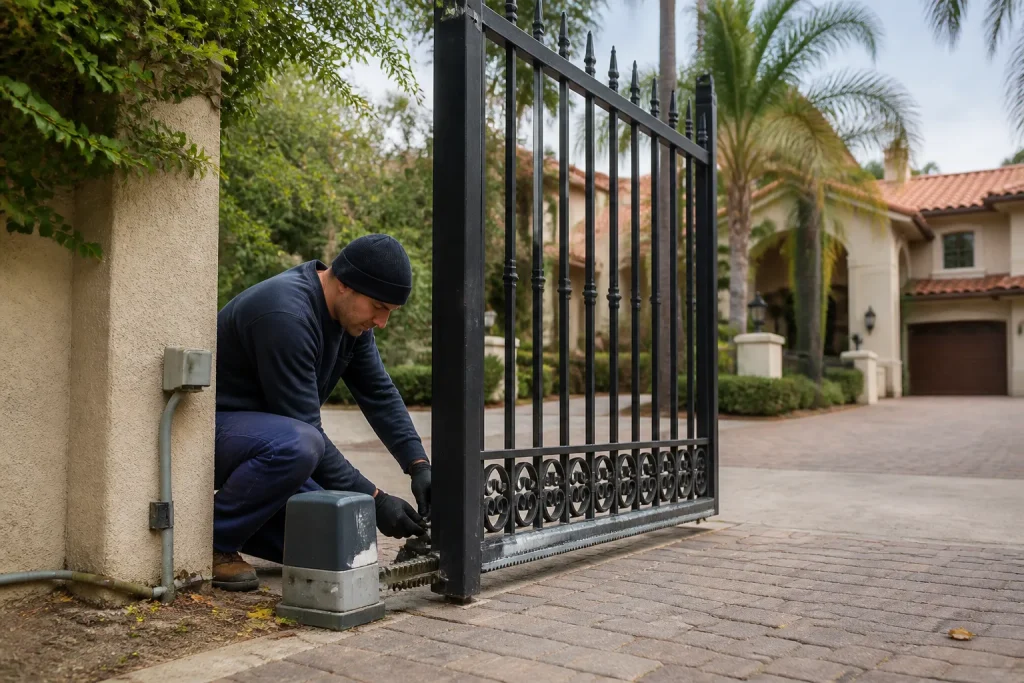
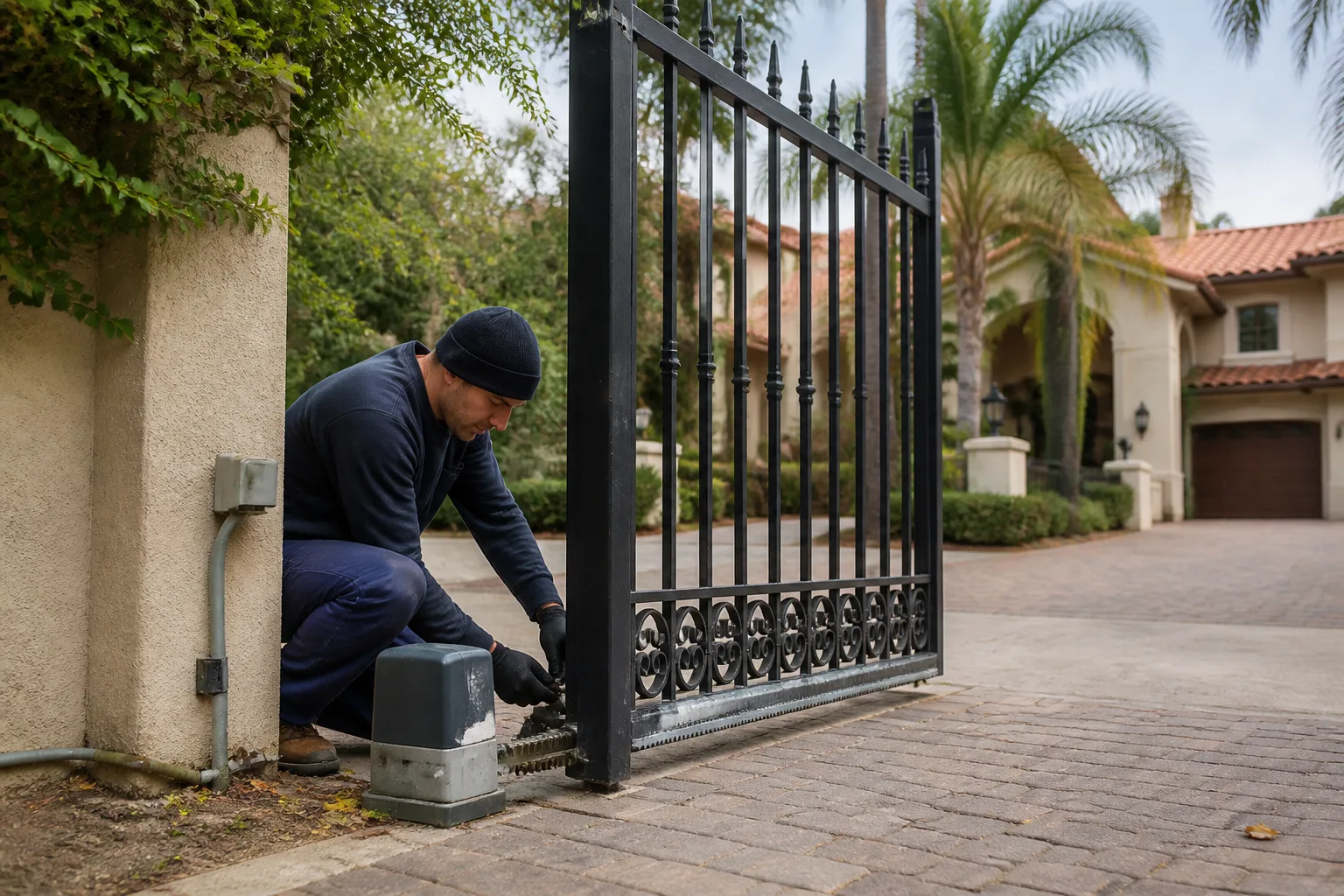
Preparing Your Home’s Gate Repair for Winter in Los Angeles
Winter gate prep in Los Angeles isn’t about snow and ice. It’s about preparing your opener and gate hardware for weeks of intermittent rain, overnight humidity, and a holiday traffic load that pushes your gate through more open-close cycles in December than it saw all summer. The four components that fail first are battery backup cells, photo-eye lenses, exposed hinge bearings, and wiring conduit seals. If you’d rather not spend a Saturday checking these yourself, call Calder Gate Repair at (903) 417-0793 and we’ll handle the full winter checklist for a written, upfront price.
Why Los Angeles Winters Are Harder on Gates Than People Expect
Los Angeles gets an average of 15 inches of rain per year, but 70% of it falls between November and March. A gate opener that performed fine through eight dry months is not ready for six weeks of daily moisture exposure without a specific set of checks. The mild weather convinces homeowners to skip maintenance, and the equipment quietly accumulates the exact kind of damage that turns into a January service call.
Here’s what we see every year at Calder Gate Repair home. In dry months, dust builds up on the photo-eye lenses. When the first real rain hits, that dust turns to a thin film of mud. The photo-eye, the small sensor that tells the gate to stop when something crosses its path, now can’t see clearly. The gate either refuses to close or reverses mid-cycle. Homeowners in Silver Lake and Echo Park call us in January convinced their opener motor died. Most of the time, it’s a dirty lens and a $15 fix.
Moisture also works its way into bearing housings and wiring seals that have been baking in the sun since April. Small cracks in conduit seals open just wide enough for water to wick inside. Once moisture reaches the control board or the limit switch, corrosion starts. The limit switch, the sensor that tells the gate when to stop at the fully open or fully closed position, is especially vulnerable. A corroded limit switch can make your gate overshoot the closed position and slam or sit ajar, which is both a security problem and an invitation for further mechanical damage.
The Four Components That Degrade Fastest During LA’s Wet Season
If you only check four things before the rainy season settles in, check these. Each one fails predictably in the Los Angeles climate, and each one is directly tied to the most common winter repair calls we run.
- Battery backup cells. Many Los Angeles gate openers run on DC power with a battery backup so the gate still works during outages. Batteries lose capacity in cold weather, and the mild-but-damp LA winter accelerates that. If the battery is over three years old, have it load-tested. A weak battery means the gate can stall mid-cycle during a power flicker, leaving it stuck open with no easy fix.
- Photo-eye lenses. As noted, dust plus rain equals a crusted lens. Clean both lenses with a dry microfiber cloth. Don’t use glass cleaner, it can leave a residue that attracts dust faster.
- Exposed hinge bearings. Gate hinges on driveways near the coast, in the canyons, or anywhere with morning marine layer, collect moisture nightly. Bearings that aren’t lubricated with a water-resistant grease will grind, then seize. A seized hinge puts enormous strain on the opener motor, shortening its life by years.
- Wiring conduit seals. Conduit runs from the opener to the gate itself, often along the ground or buried shallow. The seals where conduit meets junction boxes crack with sun exposure. When rain pools around the base of the gate, water follows the conduit and into the electrical connections. Check for cracked or missing seals and replace them before the rains arrive.
For a deeper look at how these components work together and what a full-season maintenance visit covers, see our Gate Repair in Los Angeles page.
Weatherproofing the Control Board Enclosure Without Cooking It
The gate opener control board is the brain of your automatic gate. It sits inside a weatherproof enclosure, usually a gray or black plastic box mounted near the opener or on the gate column. In Los Angeles, that enclosure survives three seasons of direct sun, then gets hit with weeks of rain. The two failure modes pull in opposite directions, and both are common winter calls for us.
First, water intrusion. The enclosure’s gasket degrades in UV light. Once it cracks, rain can seep in, and the control board is not designed to be wet. Corrosion on the board leads to intermittent failures: the gate opens but won’t close, the remote stops working, or the opener cycles on its own. These issues are fixable if caught early, but a corroded board often needs full replacement, which runs higher than a maintenance visit.
Second, overheating from over-sealing. Homeowners sometimes see the moisture risk and wrap the enclosure in plastic sheeting or silicone sealant. That blocks the enclosure’s ventilation ports. The control board generates heat during normal operation. Without airflow, that heat builds up, especially on warmer winter days, and the board can fail from thermal stress. The right approach is to replace the gasket, reseat the enclosure door, and clear any debris or dirt blocking the ventilation louvers. That keeps the rain out and the air moving.
We pulled a LiftMaster enclosure out of a garage in Brentwood last February where the homeowner had sealed the box with weatherstripping adhesive “for winter.” The board had overheated and shut down mid-cycle, leaving a 400-pound driveway gate stuck half open at 1 a.m. The fix took about 40 minutes, but it never would’ve happened if the enclosure had been left alone with a good gasket. If you’re not sure what’s safe to seal, call us at (903) 417-0793 before you reach for the caulk gun.
Hillside and Canyon Properties Face a Compounded Winter Risk
If you live in Laurel Canyon, Bel Air, Topanga, or the hills above Studio City, your gate has two additional winter problems most flat neighborhoods don’t face, and they compound each other.
The first is ground movement. Hillside soil expands when it absorbs winter rain. Driveway gates on slopes often sit on concrete pads or posts set into that same soil. When the ground shifts by even half an inch, the gate’s alignment changes. A gate that was perfectly level in September can be dragging on the low side by February. That drag means the motor works harder, draws more current, and runs hotter. Over a wet winter, that extra load shortens the opener’s life and increases the chance of a mid-season failure.
The second is debris. Canyon properties collect leaves, twigs, and mudslides during winter rain. Debris accumulates in the gate track, around the hinges, and under the gate itself. It blocks the photo-eyes and can physically jam the gate. We’ve seen gates in Topanga so jammed with wet leaves that the opener’s internal breaker tripped and wouldn’t reset until the track was cleared.
What does this mean for your limit-switch calibration? A limit switch is the sensor that tells the gate when to stop at the fully open or fully closed position. When ground movement shifts the gate even slightly, the limit switch settings no longer match the physical position of the gate. The gate might slam into the closed position because the switch thinks it has more travel left. Or it might stop short and leave a gap at the bottom. Checking and recalibrating the limit switch is a standard part of our winter service for hillside properties specifically. For canyon-area homeowners, see our Electric Gate Repair in Los Angeles page for what a full seasonal check includes.
The Holiday Traffic Spike: Your Opener’s Duty Cycle Under Winter Load
The term “duty cycle” refers to how many open-close cycles a gate opener can handle in a given period before the motor needs to cool down. Most residential openers are designed for intermittent use, a few cycles per hour at most. December is the one month when many Los Angeles homes exceed that and nobody notices until the opener quits.
Delivery vehicles, holiday guests, house sitters, dog walkers, and contractor visits all add cycles. A household that normally runs 15 cycles a day might run 40 or 50 during the holidays. That’s not inherently a problem for a healthy opener, but it becomes one when the motor hasn’t been serviced in a year and it’s now running that load in damp conditions. The extra heat from extended duty cycles compounds any existing weakness in the motor or gear train.
You can assess your opener’s condition with a simple test: run the gate through five full open-close cycles in a row, then feel the motor housing. If it’s too hot to comfortably hold your hand on for five seconds, the motor is running above its normal temperature and should be inspected before the holiday traffic peaks. Listen for changes in speed or tone between cycle one and cycle five. A motor that slows noticeably is telling you the duty cycle is overtaxing it. For brands like LiftMaster, FAAC, BFT, and Linear, these are the earliest warning signs of a failing capacitor or worn gear assembly, repairs that are much cheaper to schedule than to make as an emergency call on December 23rd.
A Concrete Pre-Winter Checklist With Real Costs
Here’s what we actually do on a Los Angeles winter prep visit, and roughly what each item costs before parts. Prices vary by opener model and gate size, but this gives you a baseline to budget against.
Most gate opener maintenance visits in Los Angeles run $150 to $250 for the inspection and basic adjustments before parts. That’s the kind of visit that checks the battery load, cleans the photo-eye lenses, lubricates hinges and bearings, tests the limit switch calibration, inspects the control board enclosure and conduit seals, and runs a duty-cycle check. If we find a part that needs replacement, you’ll see the price in writing before we order or install anything.
Here’s a breakdown of common winter prep items and their typical ranges:
- Photo-eye cleaning and alignment: included in a standard maintenance visit. No parts cost unless a lens is cracked.
- Hinge and bearing service with water-resistant grease: $40 to $90 depending on gate size and number of hinges.
- Limit switch recalibration: $60 to $120 for the adjustment. A full limit switch replacement runs $110 to $240 before the cost of the component.
- Battery backup load test and replacement: $80 to $200 for residential backup batteries, more for higher-capacity units on larger gates.
- Conduit seal replacement: $30 to $80 for most residential gates, assuming the seal is accessible and the wiring inside is in good shape.
- Full control board enclosure gasket replacement: $45 to $100 including clearing ventilation ports.
Compare that to an emergency winter repair call. A full gate opener replacement runs $600 to $1,800 before parts depending on the model and gate type. A control board replacement runs $300 to $700. An emergency service visit for a stuck gate during a rainstorm in January is often $200 to $400 just to get a technician out and diagnose the problem, before any repair labor or parts. The maintenance visit is the cheaper number every time.
We always quote the price and get your agreement before any work starts. That’s non-negotiable at Calder, and it’s exactly what our Gate Opener Repair in Los Angeles clients tell us they value most: the number on the invoice is the number agreed to at the door, never a surprise at the end.
When to Call a Pro
Most of the basic winter maintenance items on this list are safe to DIY: cleaning lenses, clearing debris, even lubricating hinges. But there are three situations where you should stop and call someone who knows the equipment.
First, if your gate is a heavy cantilever or slide gate, those systems are under constant mechanical tension. A misaligned limit switch or a seized bearing can cause the gate to jump the track or slam, and that’s a serious safety risk. Second, if you see corrosion or moisture inside the control board enclosure, do not open it up and start poking around. Turn the power off at the breaker and call us. Third, if your opener is making a grinding, buzzing, or clicking sound that’s new, that almost always indicates a mechanical problem inside the gear assembly or motor. Running it longer makes the repair more expensive and increases the chance of a gate stuck in a dangerous position.
If you notice any of these, call (903) 417-0793. A live person answers, day or night, we tell you what’s likely wrong over the phone, and we’ll give you a written price before we touch a single bolt.
The Bottom Line
Los Angeles winters are mild, but they concentrate their damage into four months of rain, humidity, and heavy gate use. The homeowners who call us in January are almost always the ones who skipped October maintenance. The fix costs less and takes less time when it’s scheduled than when it’s an emergency.
The core winter prep items are simple: clean the photo-eye lenses, lubricate the hinge bearings, check the battery backup cells, inspect the conduit seals, and recalibrate the limit switch if your gate sits on sloped ground. Budget $150 to $250 for a maintenance visit that covers all of it, plus parts if anything’s worn. That’s a small number compared to a mid-season opener replacement.
If you’re in Los Angeles and need help, Calder Gate Repair offers free estimates and a written price before any work starts. Call (903) 417-0793 and we’ll get your gate ready for the wet season properly, with the Done Right Promise on every job. If the repair fails within 365 days, we come back at no charge. Every time.
Frequently Asked Questions
A full winter prep visit typically runs $150 to $250 before parts, covering photo-eye cleaning, hinge lubrication, limit switch recalibration, battery load testing, and conduit seal inspection. Parts, if needed, are quoted separately and you’ll see the written price before anything is ordered. Call (903) 417-0793 for an exact quote, estimates are free.
Yes, because 70% of LA’s rain falls between November and March, and your gate opener has been running in dry conditions for eight months. Moisture, humidity, and the holiday traffic spike all converge in this window. The maintenance visit is cheap compared to a January emergency repair call, which often starts at $200 to $400 just for diagnosis.
Dirty or misaligned photo-eye lenses. Dust builds up during the dry months, turns to mud in the first rain, and the gate refuses to close or reverses mid-cycle. It’s usually a quick fix, but it prompts more Los Angeles service calls every January than any other issue.
You can replace a cracked enclosure gasket and clear debris from the ventilation ports. Do not wrap or seal the enclosure airtight, that traps heat and will damage the control board. If you see moisture or corrosion inside the enclosure, call (903) 417-0793 before turning the power back on.
Written by the team at Calder Gate Repair.
Need Gate Repair Help?
Call Calder Gate Repair - licensed & insured, here with fast after-hours help in Los Angeles.
(903) 417-0793