
5 Mistakes to Avoid With Electric Gate Repair
Most electric gate repair calls we take in Los Angeles aren’t caused by a broken part. They’re caused by a working part that was pushed past its limit by something the homeowner did, or didn’t do, 60 days earlier. The good news is that all five of these mistakes are avoidable once you know what to look for. If you’d rather not deal with any of this yourself, call (903) 417-0793 and we’ll sort it out.
Mistake #1: Resetting the Limit Switches Yourself
When your gate starts drifting, stopping a few inches short, or slamming at the end of its travel, it’s tempting to pop open the control box and adjust the limit switches. That’s the small set of sensors or mechanical stops that tell the gate where to begin and end its travel. It seems like a simple fix. You turn a dial or press a button, the gate behaves for a few days, and you feel like you’ve beaten the system.
What you’ve actually done is masked a bigger problem. Limit switches drift out of alignment for a reason. In our experience across Los Angeles, from Sherman Oaks to West Adams, the usual culprits are a motor that’s losing torque, a track that’s shifted out of square, or a hinge that’s worn enough to change the gate’s geometry. When you reset the switch to compensate for that underlying issue, the motor now has to work against a gate that isn’t tracking correctly. That extra strain compounds silently. We’ve opened up gearboxes where a homeowner had reset the limits three or four times over a few months, and by the time the gate finally quit, a $120 switch adjustment had become a $600 motor replacement.
The fix: have a Los Angeles electric gate repair technician diagnose why the limits drifted before anyone touches the dial. It’s a 20-minute check that usually prevents a much larger bill later.
Mistake #2: Using WD-40 on Gate Hardware
This is the single most common thing we see, and it comes from a good instinct. A noisy gate sounds like it needs lubrication, and WD-40 is what most people have on the shelf. But WD-40 is a solvent and water displacer, not a long-term lubricant. It strips away whatever grease was there, provides maybe two days of quiet, and then leaves the metal drier than before. On chain-driven openers, that accelerates wear on every link. On sliding gate rollers, it washes the bearing grease out entirely.
What you want depends on the hardware. Use a white lithium grease on hinges, rollers, and the chain. Use a dry silicone spray on the track itself, especially in Los Angeles, where the dry air and fine dust will turn heavy grease into a grinding paste that eats aluminum track. We pulled a sliding gate off its track in Echo Park last month where the owner had been faithfully spraying WD-40 on the rollers for a year. The bearings had essentially disintegrated. A $9 can of lithium grease would have prevented a $400 repair.
If you’re not sure whether your opener is chain, belt, or screw-driven, we cover brands like LiftMaster and FAAC that each use different lubricants. The manual usually says, but if it’s been lost to the garage, call us and we’ll tell you over the phone what to use on your specific model.
Mistake #3: Ignoring That First Slow-Open Cycle
Every electric gate has a normal operating rhythm. You know it: the brief pause after the remote click, the steady speed, the soft stop. When that rhythm changes, even once, it’s not a fluke. It’s data.
In Los Angeles, where gates cycle dozens of times a day on busy streets, that first slow-open is usually the earliest warning of a capacitor starting to fail, a battery losing charge on a back-up system, or a motor drawing more amps than it should. Here’s what we know from years of emergency calls: when a homeowner notices a single slow-open cycle and does nothing, a meaningful portion call for emergency service within 30 days. The gate typically fails completely in that window, often at night, often when the car is inside and the opener won’t respond. That’s not paranoia. It’s just how capacitors and DC motors fail: gradually, then suddenly.
The comparison that helps most people: you wouldn’t ignore a check-engine light and hope it goes away. That slow cycle is your gate’s check-engine light. The repair at the first sign is usually under $200 before parts. The emergency call after the failure is usually triple that, plus the tow truck if your car is stuck behind the gate.
When to call a pro: if you notice the gate is slower, louder, or pausing longer than it did last month, that’s a diagnostic signal, not a random event. We can check voltage draw, capacitor health, and motor current in one visit. In our experience, catching it early is the difference between a service call and a replacement. If you’re in Los Angeles, the relevant page is our gate opener repair service.
Mistake #4: Replacing the Remote Before Checking the Receiver Board
Here’s a scenario we hear constantly: the gate stops responding to the remote. The homeowner assumes the remote is dead, buys a new one online, programs it, and the gate still doesn’t move. Now they’ve spent $30 to $80 on a remote and they’re no closer to a working gate.
The remote is just the sender. The receiver board inside the gate opener is what actually hears the signal and turns it into movement. On most systems, especially LiftMaster and Linear models, if the receiver board loses power, has a blown capacitor, or simply needs a reset after a power surge, every remote in the house will go dead at once. That’s the tell. If all the remotes stopped working at the same time, the problem is almost never the remotes. It’s the board or the power feeding it.
We see this in Los Angeles frequently after the kind of brief power flickers that come from grid strain or wind events. A surge takes out a component on the board, and suddenly nothing responds. A board-level diagnosis costs less than you’d think, and we carry receiver boards for LiftMaster, FAAC, BFT, and other common brands. Test the simple stuff first, check the breaker, check the power light on the opener. But don’t throw money at new remotes before someone has checked the board.
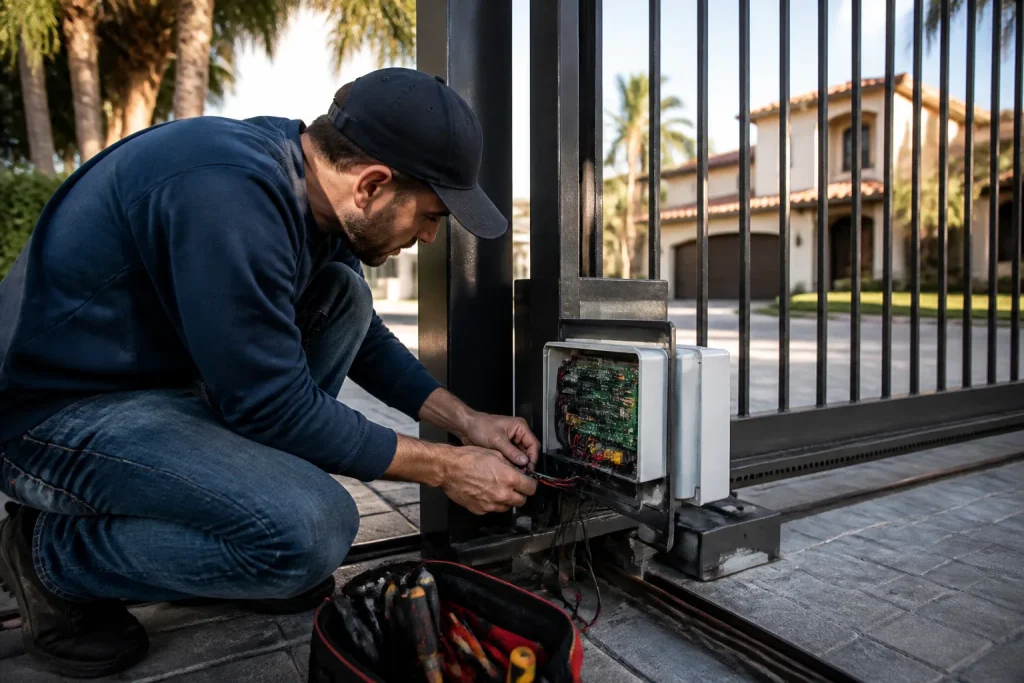
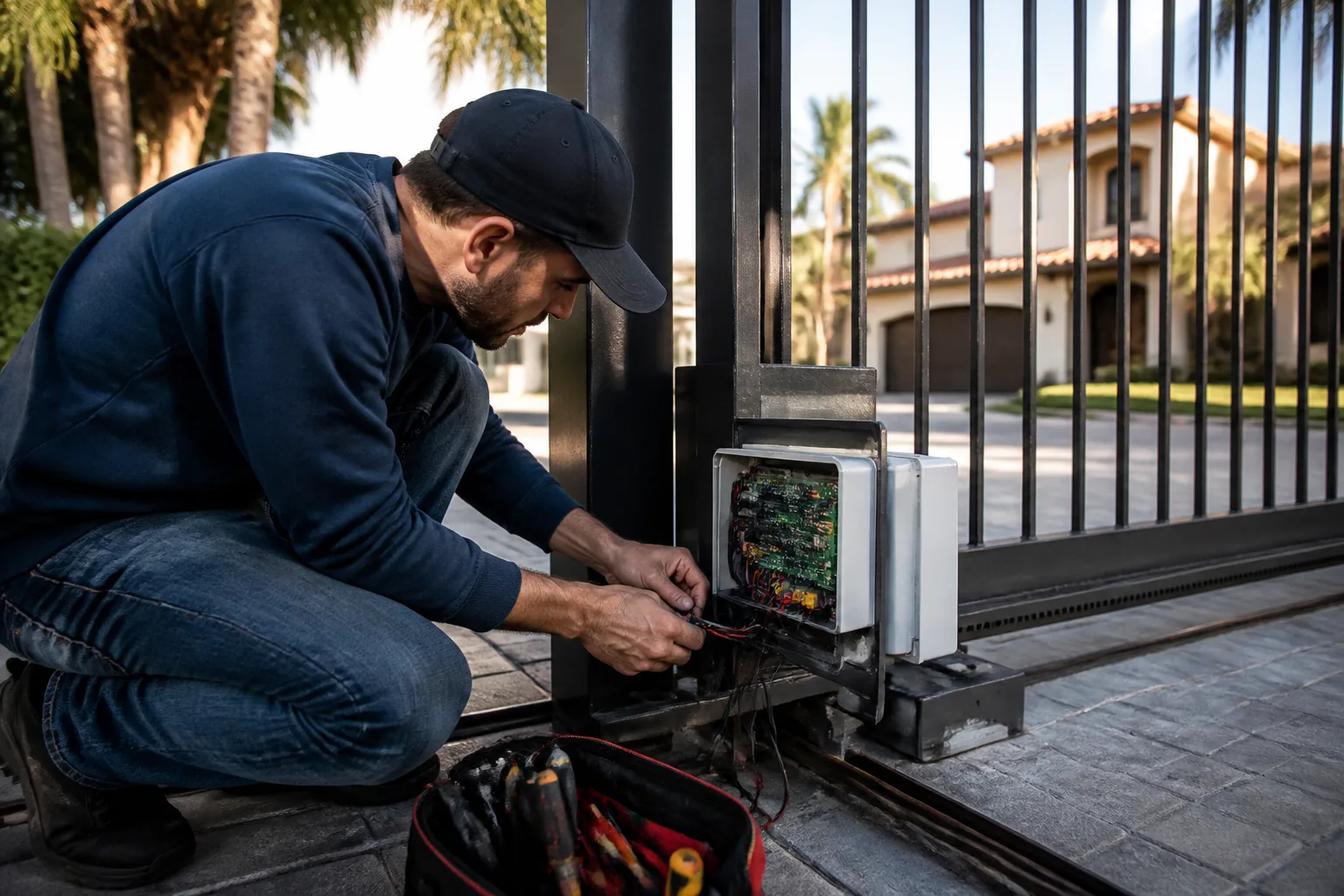
Mistake #5: Sending a Handyman Into a Brand-Specific Control Board
Electric gate control boards are not like light switches. They’re not interchangeable. A board from a LiftMaster isn’t going to work in a FAAC opener, and a BFT board doesn’t play nicely with Viking accessories. Each brand has its own logic, wiring harness, safety sensor protocols, and programming interface. And within each brand, there are board revisions where a difference of one digit changes whether the board will even power up with your existing motor.
We hear a version of this story at least monthly in Los Angeles: a homeowner hires a general handyman to save on the service fee, the handyman opens the control box, and things get worse. We’ve seen boards fried by incorrect voltage taps, wiring harnesses cut and spliced back in the wrong order, and one memorable episode where a handyman tried to bypass the safety loop entirely to get the gate to close, which disabled the obstacle detection. That’s the safety feature that prevents the gate from closing on a car, a child, a dog. You don’t want that bypassed, ever.
The honest math: a general handyman is great for fences, posts, and concrete. But a control board is the brain of the system. Get it wrong and the repair bill often doubles, because now we’re not just fixing the original fault, we’re undoing whatever happened after that. We work on these boards daily, and we’re factory-familiar with LiftMaster, FAAC, BFT, and Linear. That matters when the fix requires knowing the difference between a firmware issue, a voltage drop, and a genuinely dead board.
How Calder Gate Repair Approaches Electric Gate Repair Differently
We’re part of the Relay Home Co. family, and we’ve focused our entire business on gate repair in Los Angeles. That focus means we’ve seen the same five mistakes hundreds of times, and we’ve built our process to prevent them from ever becoming repeat problems.
Three things are non-negotiable on every job. First, you get a written price before any work starts. The number on the invoice is the number you agreed to at the door, not a surprise that appears after the gate is in pieces. Second, every repair carries a written guarantee. We call it the Done Right Promise: if the repair fails within 365 days, we come back and make it right at no charge. Third, a live person answers our phones 24/7. Not a voicemail, not a chat bot. When your gate is stuck at 11 p.m., you talk to someone who can actually help.
When You Should Just Call Instead
Some gate problems are safe to investigate yourself: a dead remote battery, a tripped breaker, a photo-eye that’s visibly blocked by a plant. We’ll happily walk you through those over the phone. But when the issue involves the control board, the limit switches, the motor, or any wiring, that’s a different story. Electric gates carry enough voltage and enough stored mechanical energy to hurt someone who doesn’t know what they’re touching. A gate closing under power can do real damage. If you’re not sure, the safest move is to leave the cover on and call.
We schedule everything by phone, dispatch a background-checked technician with a trackable arrival time, and send you a digital invoice you can pay from a link after the work is done. You see the before-and-after photos, you see what was replaced, and you get a receipt you can actually find later. That’s the whole point of how we do business.
The Bottom Line
Electric gate failures in Los Angeles follow a pattern, and that pattern usually starts weeks before the gate actually stops. A reset limit switch masks a motor problem. WD-40 kills hardware it was never meant to lubricate. A single slow cycle is a warning sign, not a fluke. A dead remote doesn’t necessarily mean a bad remote. And a general handyman is the wrong person for a brand-specific control board.
If you catch the problem at the first signal, most repairs are modest. If you wait, the cost climbs fast. If you’re in Los Angeles and your gate is doing any of these things, call us before it gets worse. Calder Gate Repair offers free estimates, written pricing before any work starts, and a Done Right Promise on every repair. Call (903) 417-0793.
Frequently Asked Questions
Most electric gate repairs in Los Angeles run between $150 and $400 before parts, with control board replacements and full motor swaps pushing higher. Every Calder Gate Repair job includes a written price before any work begins, so you’ll know the total before anything gets taken apart. Call (903) 417-0793 for an exact quote, estimates are free.
In most cases, yes. Our technicians carry common parts for LiftMaster, FAAC, BFT, and Linear openers, so many repairs are completed in a single visit. If you’re locked in or locked out, call (903) 417-0793 and we’ll give you a trackable arrival time from a live person, not an answering service.
Intermittent operation usually points to one of three things: a failing capacitor, a receiver board with a loose power connection, or limit switches that have drifted out of alignment. The first two get worse with heat, which is why so many Los Angeles homeowners notice intermittent failures on hot afternoons. The best move is a diagnostic visit before the problem becomes permanent.
If the keypad opens the gate but the remote doesn’t, the receiver board is working, which means the issue is the remote itself, usually a dead battery or a lost programming link. Try a fresh battery first. If that doesn’t do it, the remote may need to be re-paired or replaced. We can walk you through that over the phone, or send a tech if you’d rather not fuss with it. Call (903) 417-0793.
Written by the team at Calder Gate Repair.
Need Gate Repair Help?
Call Calder Gate Repair - licensed & insured, here with fast after-hours help in Los Angeles.
(903) 417-0793