
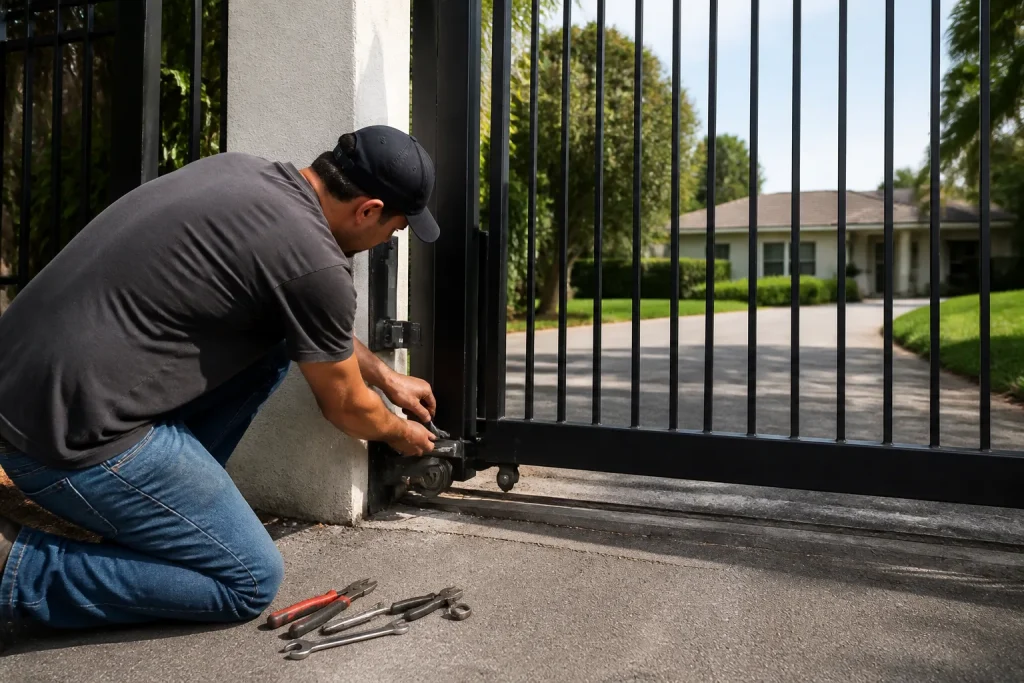
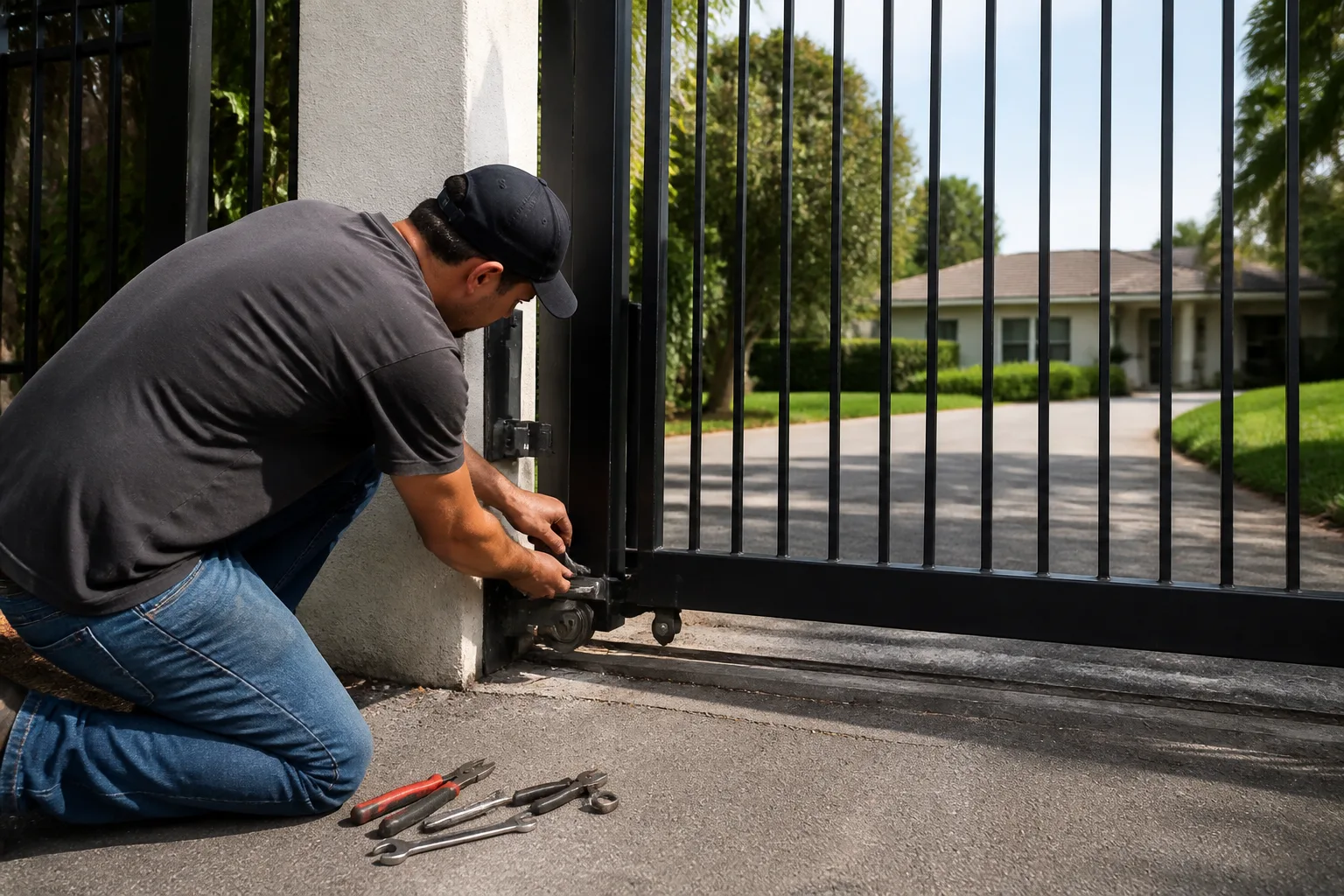
5 Mistakes to Avoid With Gate Repair
Most gate repairs are avoidable, but not in the way you might think. The expensive problems we see across Los Angeles usually start with a well-intentioned homeowner doing something in the 20 minutes before calling us. A quick spray of lubricant, a firm push on a stuck gate, a “simple” fix watched on YouTube. These small moves void warranties, destroy motors, and turn a $200 job into a $1,400 replacement. Here are the five mistakes that cost the most, and how to skip every one of them. If you’d rather not deal with any of this, call (903) 417-0793 and we’ll handle it.
The WD-40 problem (and what actually belongs on a gate hinge)
Spraying WD-40 on a squealing hinge is the most common pre-repair mistake we see. It feels right. It smells right. And it’s actively making the problem worse. WD-40 is a water displacer, not a long-term lubricant. It washes out the factory grease packed into the hinge barrel, then evaporates, leaving the metal dry. Worse, the thin film it does leave attracts dust and grit, which grinds against the pin like sandpaper. In neighborhoods like Sherman Oaks and Encino where dry wind kicks up fine dust, we see hinges destroyed within a season of regular WD-40 use.
What actually belongs on a gate hinge? A lithium-based white grease or a marine-grade grease for metal-to-metal pivot points. Chains need a tacky, open-chain lubricant. Rollers on a sliding gate track should stay dry, or at most get a dry silicone spray that won’t hold grit. If you’re unsure which component gets which product, don’t guess. The wrong lubricant is worse than none, and we’ve pulled more Wd-40-soaked hinges out of gates in Los Angeles than any other single repair.
Forcing a stuck gate before releasing the manual bypass
When a gate won’t move, the instinct is to shove it. That instinct is expensive. Most electric gate openers have a manual bypass release, usually a small key or pull handle on the motor housing. It disconnects the drive mechanism so you can move the gate freely by hand. If you push before releasing it, you’re fighting the motor’s gearbox through the arm. Something has to give, and it’s usually the arm, the mounting bracket, or a plastic drive gear inside the opener.
We saw exactly this on a LiftMaster LA400 over in Woodland Hills last month. The homeowner pushed the gate open with the bypass still engaged. It took about 15 seconds and bent the arm enough to rack the frame. That one push turned a limit-switch adjustment, which is a quick fix, into a full opener replacement. The rule is simple: if the gate doesn’t move with the remote, find the bypass release first. Most units have one. If you can’t find it, or the gate still won’t budge after releasing it, that’s a diagnostic signal, not an invitation to try harder. Call a technician. Call us at (903) 417-0793 and we’ll walk you through finding the bypass before you touch the gate.
Misreading the warranty before a DIY component swap
It reads like a software terms-of-service that everyone scrolls through and nobody reads. But the warranty language on a LiftMaster, FAAC, or Mighty Mule opener is starkly specific about what voids coverage, and one afternoon of amateur work can erase three years of protection. Most major brands require that any component removal, board replacement, or wiring modification be performed by an authorized technician. It’s not just about brand protectiveness. It’s about liability and the fact that a miswired control board can fry the motor and the transformer in the same second.
Here in Los Angeles, many homes have gate openers that came with the property, which means the original warranty registration is either lost or in the previous owner’s name. We see homeowners assume there’s no coverage and start swapping parts themselves. Sometimes warranty coverage still exists, and the first move should be a phone call. Before you unplug anything, check the model number, the install date, and what the agreement says about unauthorized service. A simple phone call to the manufacturer or a quick search of the warranty document can save you hundreds. And if you’re not sure whether a repair is covered, a professional diagnostic is cheaper than voiding a warranty by accident. The Gate Opener Repair in Los Angeles team at Calder Gate Repair can tell you up front what’s likely covered and what isn’t.
Hiring on the lowest quote without reading what’s included
Everyone wants a good price. But the lowest quote is often the most expensive by the time the invoice arrives. In gate repair, a classic lowball strategy is quoting labor only and leaving parts as a line item to be “determined on site.” Then the technician shows up, discovers the arm needs replacement, and suddenly there’s a $380 part on a quote that promised $150. The homeowner feels stuck. The technician has already started. The price climbs.
We’ve seen this pattern in every corner of Los Angeles, from the Westside to the Valley. The tell is always the same: a verbally quoted number with no itemized breakdown. A legitimate gate repair estimate costs out the full job before anyone arrives. That means parts, labor, and any variables that could affect the price. At Calder Gate Repair, every customer gets a written price before any work starts. It’s not a courtesy, it’s how we operate. No “we’ll let you know when we get there.” No open-ended parts line. If a quote doesn’t spell out the full scope in writing, get another quote. The $50 you save on a lowball estimate can become a $600 surprise in the driveway.
Two safe ways to filter quotes before anyone is at your gate: ask for the line items on the estimate, and ask what happens if the job runs into a complication. A professional will answer both without hesitation. A lowballer will stall.
Skipping a written quote and letting the price stay verbal
This is the mistake that generates most of the billing disputes we hear about. A technician says the job will be “around $300.” The job gets done. The invoice says $480. Why? A part was more expensive than expected, or the job took longer, or there’s a labor surcharge that was never mentioned. Verbal price agreements in gate repair are almost impossible to enforce after the fact, and they’ll sour a successful repair into a resentful one.
A written, itemized estimate solves this before it starts. It locks in the number, names the parts, and gives you a record that protects you if anything changes. And the cheaper fix is often a text message. If you’ve already agreed on a price verbally, send a text that says, “Just confirming the job is $300 total including all parts and labor. Let me know if anything about that changes before you start.” That one message takes ten seconds and creates a paper trail. It changes the entire dynamic. In Los Angeles, where contractors come and go, that text is your only leverage. It’s also the first thing we recommend if you’re working with a handyman or a generalist rather than a gate specialist.
If you’re looking for a team where the written price is standard, not a negotiation, start with the Calder Gate Repair home page or have a look at our Gate Repair in Los Angeles services.
When to call a pro (and when to try it yourself)
Some gate tasks are genuinely fine to handle yourself. Cleaning the track on a sliding gate, tightening a loose bolt, or clearing debris from the photo-eye sensors are all reasonable weekend jobs. But the moment you’re touching the motor, the control board, the wiring, or the tension on the gate itself, you’re in pro territory. Gate openers carry enough torque to cause serious injury, and a gate that closes unexpectedly can do real damage. There’s no shame in calling. There is shame in calling after a DIY attempt has added $400 to the job.
We pulled one out of a garage over in Highland Park where a homeowner had attempted a board swap on a FAAC 400 and crossed two low-voltage wires. The board was dead, the new board was dead, and the transformer had scorched the housing. The original problem was a bad capacitor. It would have been a $180 repair. By the time we finished, it was a full opener replacement. The homeowner said he’d watched a video and it looked “pretty straightforward.” It always does.
For the electrical side of things, check our Electric Gate Repair in Los Angeles page. If the opener itself is acting up, Gate Opener Repair in Los Angeles covers the brands we service every day.
The Bottom Line
Gate repair mistakes cluster around one theme: moving without thinking. Lubricating without knowing what you’re lubricating. Pushing without releasing. Repairing without reading. Hiring without seeing the itemized number. Agreeing without writing it down. The common thread is that every one of these mistakes happens before the technician even arrives, and each one is avoidable with five minutes of patience and a little respect for what the gate is actually doing.
Key takeaways:
- Never use WD-40 on gate hinges. It strips grease and invites grit. Use lithium grease for pivots, dry silicone for tracks.
- Always release the manual bypass before pushing a stuck gate. Forcing it can bend the arm and destroy the drive gear.
- Read the warranty before removing parts. LiftMaster, FAAC, and Mighty Mule all include clauses about unauthorized service.
- A lowball quote often quotes labor only and buries parts costs. Ask for line items.
- Get every price in writing. A quick text confirmation is enough to protect you.
If you’re in Los Angeles and a gate is acting up, you don’t have to diagnose it alone. Calder Gate Repair offers written, upfront pricing before anything is touched, and every repair is backed by the Done Right Promise. A live person answers 24/7. Call (903) 417-0793 for a free estimate.
Frequently Asked Questions
First, release the manual bypass on the opener so you’re not fighting the motor. Then check for visible obstructions on the track or in the gate’s path. If it still won’t move smoothly by hand, stop forcing it. A stuck gate is a symptom, and continuing to work it increases the damage. Call a gate technician for a diagnostic. In Los Angeles, Calder Gate Repair can often be at your gate the same day when the issue is urgent.
Most gate opener repairs in Los Angeles run between $180 and $450 before parts, depending on whether you’re dealing with a limit switch, a capacitor, a control board, or an arm. Full opener replacements usually start around $900 and climb from there based on brand and gate size. The number you should insist on is an itemized written quote before any work starts. That’s the only way to avoid a parts surprise. Call (903) 417-0793 and we’ll give you a real price range for your specific opener before we even mention scheduling.
It depends on the brand, the age of the unit, and what’s broken. LiftMaster and FAAC warranties typically cover manufacturing defects for a set period, but they exclude wear parts like chains, belts, and hinges, and most void coverage if an unauthorized person modifies the wiring or replaces a board. If you’re unsure whether your repair falls under warranty, check the install date and model number first, then call the manufacturer. A professional diagnostic that confirms a warranty claim is cheaper than accidentally voiding one.
In most cases, yes. We come prepared with common parts for LiftMaster, FAAC, Mighty Mule, and other major brands, and our schedule in Los Angeles is built around urgent repair calls, not multi-week waits. When you call (903) 417-0793, a live person answers, and we can usually tell you right then whether same-day service is available for your issue. If the part is unusual, we’ll tell you that up front too, not after we’re standing in your driveway.
Written by the team at Calder Gate Repair.
Need Gate Repair Help?
Call Calder Gate Repair - licensed & insured, here with fast after-hours help in Los Angeles.
(903) 417-0793