
Ghost Controls Gate Repair in Los Angeles: A Homeowner’s Guide
Ghost Controls gate openers are popular in Los Angeles for their solar-friendly design and DIY installation, but they fail differently here than they do on rural properties. The most common Ghost Controls repair calls we see in LA come down to one thing: these actuator arms are rated for about 15 duty cycles a day, and a busy LA driveway easily pushes 40 or more. That mismatch wears the gear train and motor brushes out fast, and the symptoms can look confusing if you don’t know what to look for. If you’d rather not troubleshoot it yourself, call us at (903) 417-0793 and we’ll walk you through what’s happening before you spend a dime.
Key Takeaways:
- Ghost Controls arms are built for low-traffic driveways, not 40-plus cycles a day
- LA’s coastal fog and canyon shade cause solar battery drain that mimics motor failure
- A failed actuator arm is a $300 – $450 fix; a fried control board often means a brand decision
- Warranty claims need specific documentation, and we’ll show you exactly what to gather
- Sometimes replacing the whole opener with a higher-duty-cycle brand is the cheaper 3-year move
How Much Does Ghost Controls Gate Repair Cost in Los Angeles?
Most Ghost Controls repairs in Los Angeles run $180 – $340 in labor before parts, with the most common parts adding another $120 – $450 depending on whether we’re replacing a limit switch, a control board, or the full actuator arm itself. That’s the honest range, and we quote the full number in writing before any work starts, never after. A simple limit-switch fix, the small sensor that tells your gate when to stop, is usually under an hour and lands on the low end. A full actuator swap with new mounting hardware and a fresh battery lands higher. We’ve pulled Ghost Controls arms out of gate posts in neighborhoods from Sherman Oaks to El Sereno where the original install was fine but the duty cycle wasn’t. When you call, we’ll ask what the gate is doing or not doing, give you a real price range over the phone, and stand behind the written quote when our tech arrives.
Why Ghost Controls Gates Fail Differently in Los Angeles
Ghost Controls designed their gate arms for exactly what the name says: quiet, low-frequency driveway access. That works perfectly on a 2-acre property off the 14 freeway where the gate cycles maybe 8 times a day. It does not work as well on a busy corner lot in West Adams or a shared driveway in Glassell Park where the gate opens and closes 40, 50, sometimes 60 times between 6 a.m. and 8 p.m. Every cycle wears the internal gear train a little. At 40-plus cycles a day, the lightweight actuator reaches its wear limit in 18 to 24 months instead of the 5 to 7 years a rural property would see.
Here’s what early strain looks like, in plain terms:
- Slower travel than when it was new. If your gate used to swing in 12 seconds and now takes 16, the motor is working harder against internal wear.
- Intermittent mid-travel stops. The actuator’s internal obstruction sensing gets jumpy when the gear train is sloppy.
- A grinding or clicking noise at the hinge point of the arm. That’s not a lubrication issue, it’s gear wear and it only gets louder.
- The gate closes fine but won’t open all the way. The arm loses range as the internal stop wears, so it thinks it’s done when it isn’t.
If you’re in Los Angeles and noticing any of these, write down when it started and whether it’s worse in the morning after the gate sat all night. That detail helps us diagnose faster and avoid a wasted service fee.
The Solar Problem LA’s Fog and Canyon Shade Create
Ghost Controls is one of the few opener brands that runs genuinely well on solar power, which is why so many LA homeowners pick it. But solar placement in this city is trickier than the quick-start guide implies. A panel that faces west into the marine layer over Playa del Rey only gets useful sun for about 4 hours a day. A panel tucked under a mature oak in Laurel Canyon is shaded half the afternoon. A panel installed flat on top of a gate post instead of angled 30 degrees toward true south collects maybe 60% of the power it should.
The result is a battery that never fully recharges. And a perpetually half-charged Ghost Controls battery creates symptoms that look like motor failure: the gate won’t open in the morning, the actuator tries and quits, the control board beeps and flashes a fault that the manual attributes to a motor overcurrent. But the motor is fine. The battery just doesn’t have the voltage to complete a full travel cycle under load.
Before you call anyone, do this: check the battery’s resting voltage with a basic multimeter. A fully charged 12-volt deep-cycle battery should read 12.6 to 12.8 volts at the terminals. If you’re reading 12.3 or lower on an otherwise sunny LA afternoon, your panel placement is the problem, not the actuator. Also, look for corrosion on the solar panel’s quick-connect terminals. Salt air near the coast, from San Pedro up through Pacific Palisades, corrodes those little connectors faster than inland dry air will.
Actuator Failure vs. Control Board Failure: Know Before You Call
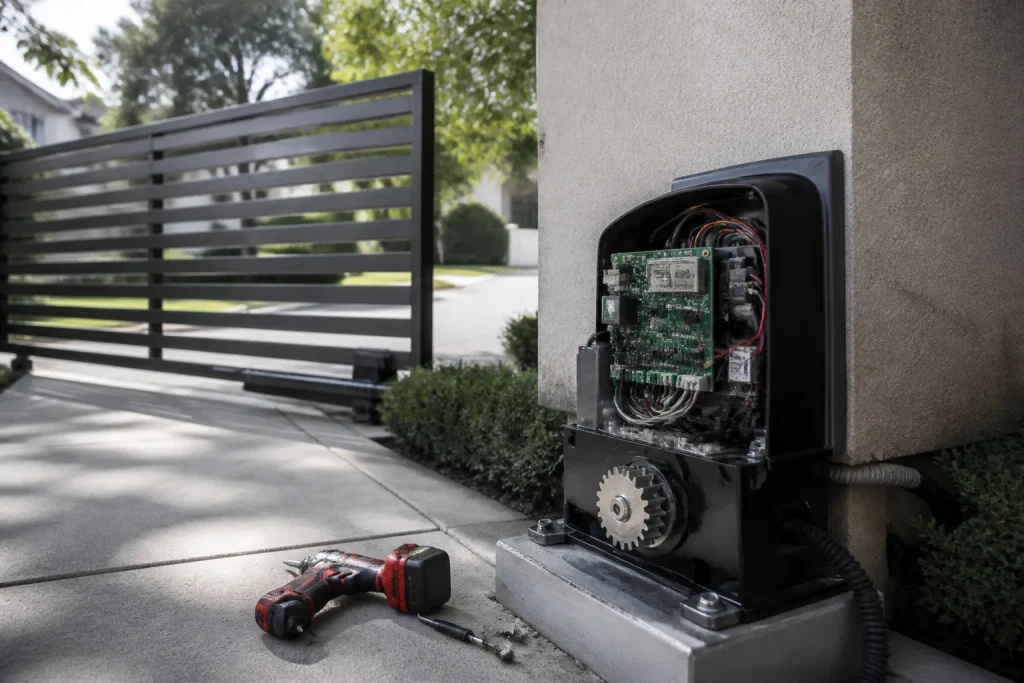
This is the fork in the road, and it determines whether you’re spending $300 or $650. Ghost Controls systems have two main failure points: the actuator arm, which is the mechanical hinge that pushes and pulls the gate leaf, and the control board, which is the logic brain that tells the motor when to start, stop, and reverse. The symptoms overlap enough that we see a lot of Los Angeles homeowners misdiagnose one for the other.
Here’s a straightforward way to tell them apart:
- The gate does absolutely nothing, no click, no hum, no movement, but the control board’s lights are on. That’s most likely a drained or dead battery, not either component. Charge or replace the battery first, it’s the cheapest check.
- The control board clicks, and the arm tries to move but stalls midway or grinds. That’s almost always the actuator’s gear train. The board is sending the signal; the mechanical arm can’t execute it.
- The gate moves erratically, stops at random points, or ignores the remote’s limits even after reprogramming. That’s usually the control board’s limit-sensing logic. A board replacement is the fix.
- The gate was fine before a power surge or nearby lightning strike and hasn’t worked since. Control boards dislike power spikes, and big stretches of Southern California during monsoon season see them. You’ll probably need a new board.
A new Ghost Controls actuator arm runs about $200 – $260 from most suppliers in LA, plus the labor to swap and reprogram the travel limits. A new control board runs $250 – $350, plus the labor to match it to your existing remote codes and safe-force settings. In our experience, if the arm is more than 3 years old and heavily used, it’s usually the arm. If the system is older than 4 years and dead after an electrical event, it’s the board. Brands like FAAC and BFT handle these same two failure modes with heavier-gauge components, but Ghost Controls parts are lighter by design, and the price reflects that.
Ghost Controls Warranty Claims: What LA Homeowners Need to Avoid a Denial
Ghost Controls offers a limited warranty on their openers, and like every other gate opener brand we service, the warranty is only good if the documentation is in order. A denied claim is usually not because the company is unreasonable, but because the homeowner can’t produce the two or three specific things the warranty department asks for. Here’s what you should gather before filing:
- Original proof of purchase. A copy of the receipt, the Amazon order number, or the invoice from the installer. Ghost Controls asks for this on nearly every claim. If you bought the opener from a third-party seller on an online marketplace, take a screenshot of the order detail page now, before the listing disappears.
- The opener’s serial number. It’s printed on a label on the actuator arm’s housing. Take a clear photo of it with your phone and save it somewhere you can find it later.
- A short video of the failure. Show the gate attempting to open, the control board’s lights and error codes, and any noise. Warranty processors respond much faster to 20 seconds of video than to a written description.
- Date of installation and the installer’s name if it wasn’t you. This matters because the warranty clock starts on the date of purchase or the date of installation, whichever satisfies the claim, and you want both options.
If you file a claim and Ghost Controls approves it, they’ll typically ship the part to you at no charge, but you’re still responsible for the labor to install it unless you do it yourself. That’s an important point for LA homeowners who can’t take a weekday off to wrench on a gate. The labor is never free, and the part warranty only covers the part. When you’re weighing a warranty claim versus a paid repair, factor in the value of your own time. We’ve had Sherman Oaks customers spend three weeks waiting on a warranty part to save $180, which is a losing trade when your gate currently doesn’t close and your driveway is open to the street.
Repair or Replace: When a Ghost Controls Opener Isn’t the Right Long-Term Call
Here’s the honest math: Ghost Controls makes a solid, affordable opener. But if your LA driveway sees 30-plus cycles a day, this brand wasn’t built for that workload, and no repair will change that. We see this on shared driveways, apartment buildings with 4 to 6 units, and families with multiple cars and active schedules in neighborhoods like Atwater Village and Koreatown. The actuator will last 18 months, then you’ll replace it, then 18 months more, then again. After the second replacement, you’ve spent close to what a higher-duty-cycle opener would’ve cost from the start.
In those cases, we level with you and say so. Brands like Linear and Viking build actuators rated for 40 to 60 duty cycles a day, and a hybrid option from FAAC splits the difference with a heavier arm at a mid-range price. A new opener from one of these brands is typically $1,200 – $1,800 installed in Los Angeles, depending on your gate’s weight and whether you want battery backup or solar integration. That’s a bigger check than a $400 actuator swap. But it’s the right call if you’re replacing that actuator every 18 months and still dealing with mornings when the gate won’t open because the battery’s weak.
If your cycle count is under 20 a day and your Ghost Controls unit is less than 3 years old, repair makes sense. Replace the worn part, relocate the solar panel if needed, and you’re likely fine for years. If the cycle count is high, treat this as the moment to make a brand decision, not just a part decision. We’ll give you both options with real prices and let you choose. That’s the job.
When to Call a Pro
Some Ghost Controls issues you can handle yourself with a multimeter and some patience. But if you’re dealing with a grinding actuator, a control board that won’t hold its limits, or a solar system that’s not charging despite a full day of direct sun, call a tech who works on this brand weekly. The actuator arm on a Ghost Controls gate operates under spring tension when the gate is closed, and removing it without releasing that tension can snap it back with enough force to injure you. We never recommend a DIY actuator removal on a loaded gate. If the gate is stuck halfway and you can’t manually release it with the included key, that’s another pro call. We answer live 24/7 at (903) 417-0793, and we’ll tell you over the phone whether it’s safe to touch or whether you should leave it until we arrive.
Related services in Los Angeles: Gate Repair in Los Angeles covers the full range of gate issues, and Electric Gate Repair in Los Angeles is the page to read if your gate’s electrical system is doing something strange. For opener-specific problems across all the major brands, see Gate Opener Repair in Los Angeles and start your search at the Calder Gate Repair home page.
The Bottom Line
Ghost Controls gates are good openers for the right property, and plenty of LA homeowners use them successfully for years on low-traffic driveways. The failure patterns we see are almost always about duty cycle, solar placement, or a misunderstanding of which component actually failed. If your gate is grinding, stopping midway, or dead after a power event, the fix may be simpler than you think. And if it isn’t, the answer may be a different brand strategy rather than another short-life part replacement. Whatever the situation, you should know exactly what’s wrong and what it costs to fix before anyone touches the gate.
If you’re in Los Angeles and need help, Calder Gate Repair offers free estimates and a written price before any work starts. Call (903) 417-0793 and we’ll give you a straight answer, a realistic price, and a guarantee in writing. If the repair fails within 365 days, we come back at no charge. That’s our Done Right Promise, and it’s on every job we do.
Frequently Asked Questions
Yes, but only if the panel is placed correctly. Solar panels need 6 to 8 hours of direct sun to maintain the battery, and LA’s coastal fog, canyon shade, and the habit of mounting panels flat on gate posts all reduce that. The return of marine layer mornings from June through August cuts production further. If your gate opens fine in the afternoon but not in the morning, your solar setup is the likely weak point. A correctly angled panel fixes more Ghost Controls battery complaints in LA than a new battery ever does. Call (903) 417-0793 for a free evaluation of your panel placement.
On a driveway with 40-plus cycles a day, expect 18 to 24 months before you notice grinding, slowed travel, or intermittent stops. On a low-traffic residential gate that cycles fewer than 15 times a day, the same actuator can last 5 to 7 years. This is a duty-cycle limitation, not a manufacturing defect. If your gate gets heavy use and you’ve already replaced the arm once, ask whether a higher-duty-cycle opener would save you money over the next few years.
Generally no. Shared driveways in Los Angeles see cycle counts that triple what this opener was designed for, and that’s not a brand weakness, just a mismatch. For shared or high-traffic access, a gate opener from Linear or Viking rated for 40-to-60 cycles a day is the more durable pick. We regularly replace Ghost Controls units on multi-unit LA properties for exactly this reason, and the owners rarely regret the upgrade once the repairs stop stacking up.
The control board is the most likely casualty. Power surges, nearby lightning strikes, and even certain types of grid switching during LA heat waves can knock out a Ghost Controls board. Unplug the system, wait 60 seconds, and power it back on. If the board lights normally and the gate responds to the remote, you’re clear. If it’s dark or behaving erratically, you’ll likely need a new board. We quote board replacements in writing before starting, and we’ll match your existing remotes and limits so the fix is seamless. Call (903) 417-0793 to talk through what you’re seeing.
Written by the team at Calder Gate Repair.
Need Gate Repair Help?
Call Calder Gate Repair - licensed & insured, here with fast after-hours help in Los Angeles.
(903) 417-0793