
Last updated October 9, 2026
Free on-site gate assessment - hinges, posts, and your LiftMaster or Nice gate operator checked before anything is quoted
The assessment is free and the quote is the invoice.
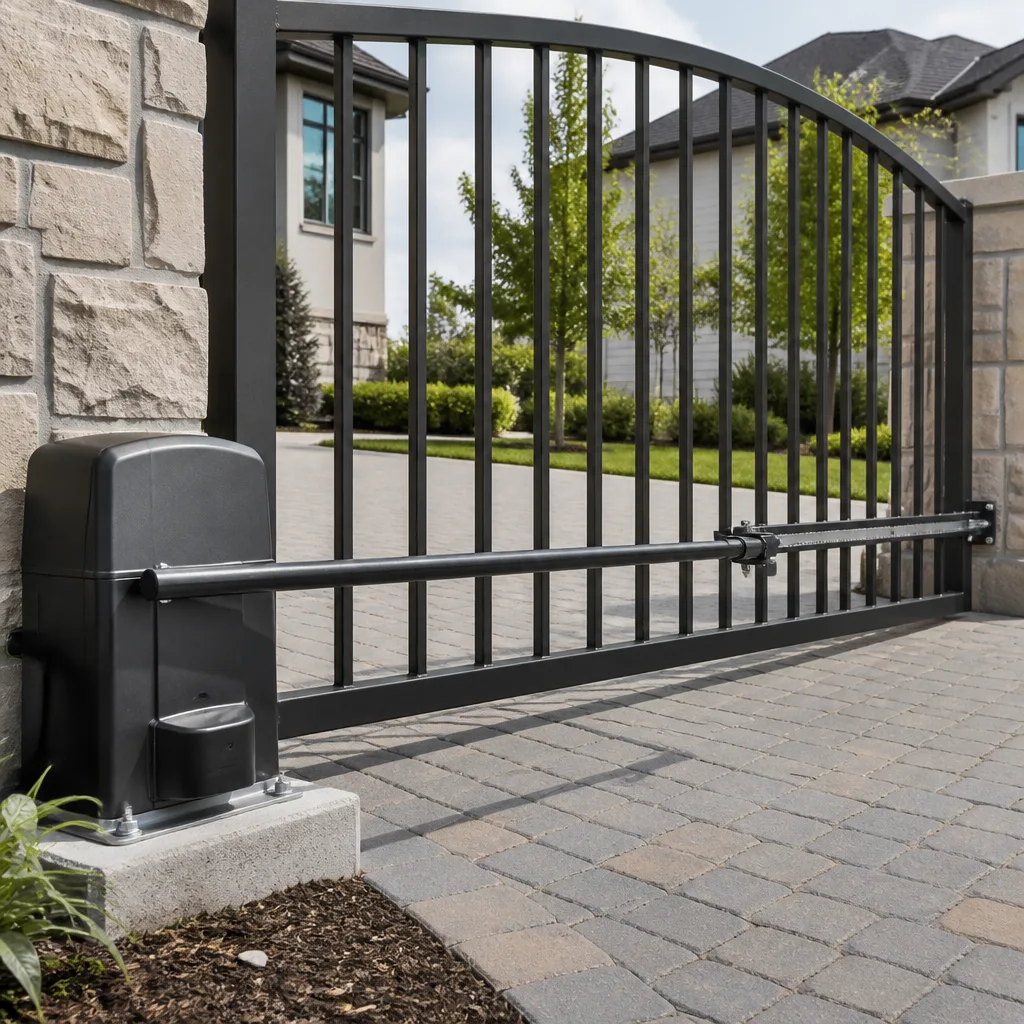
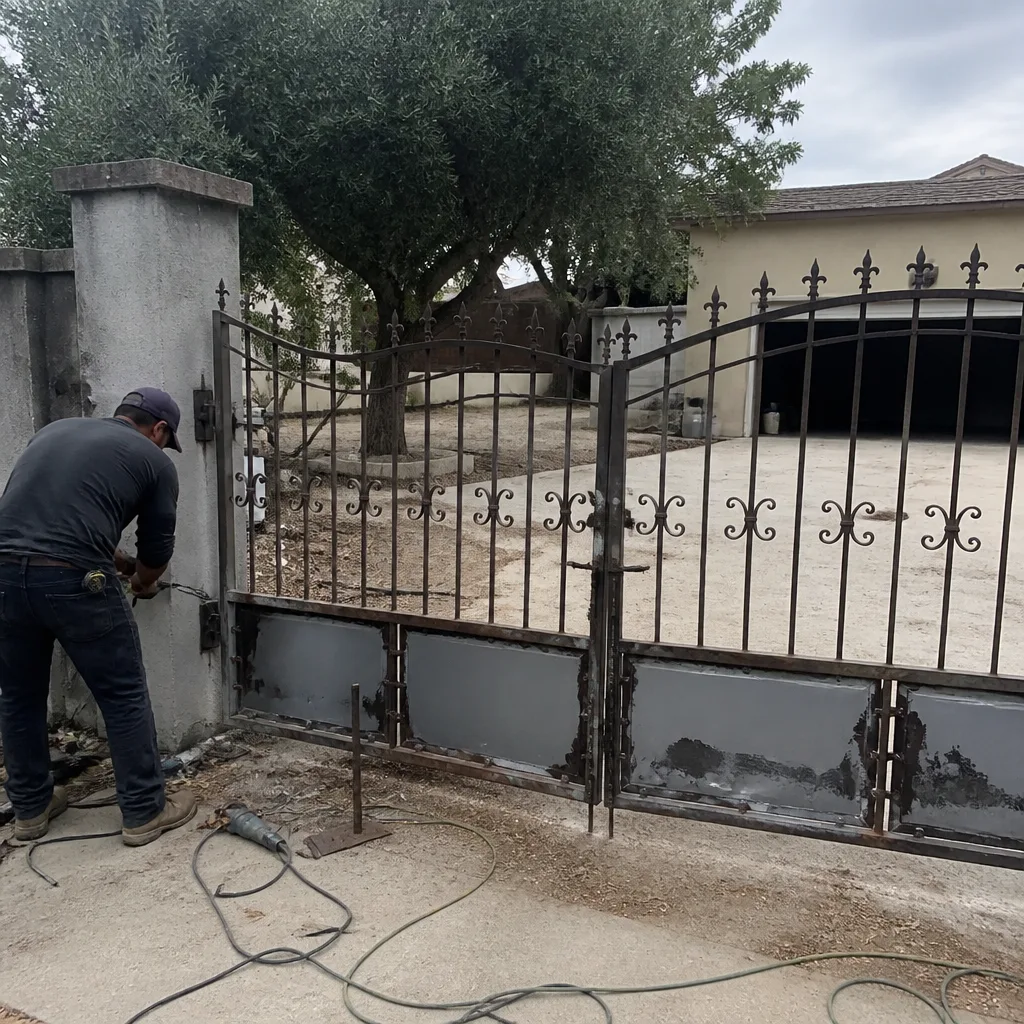 Before
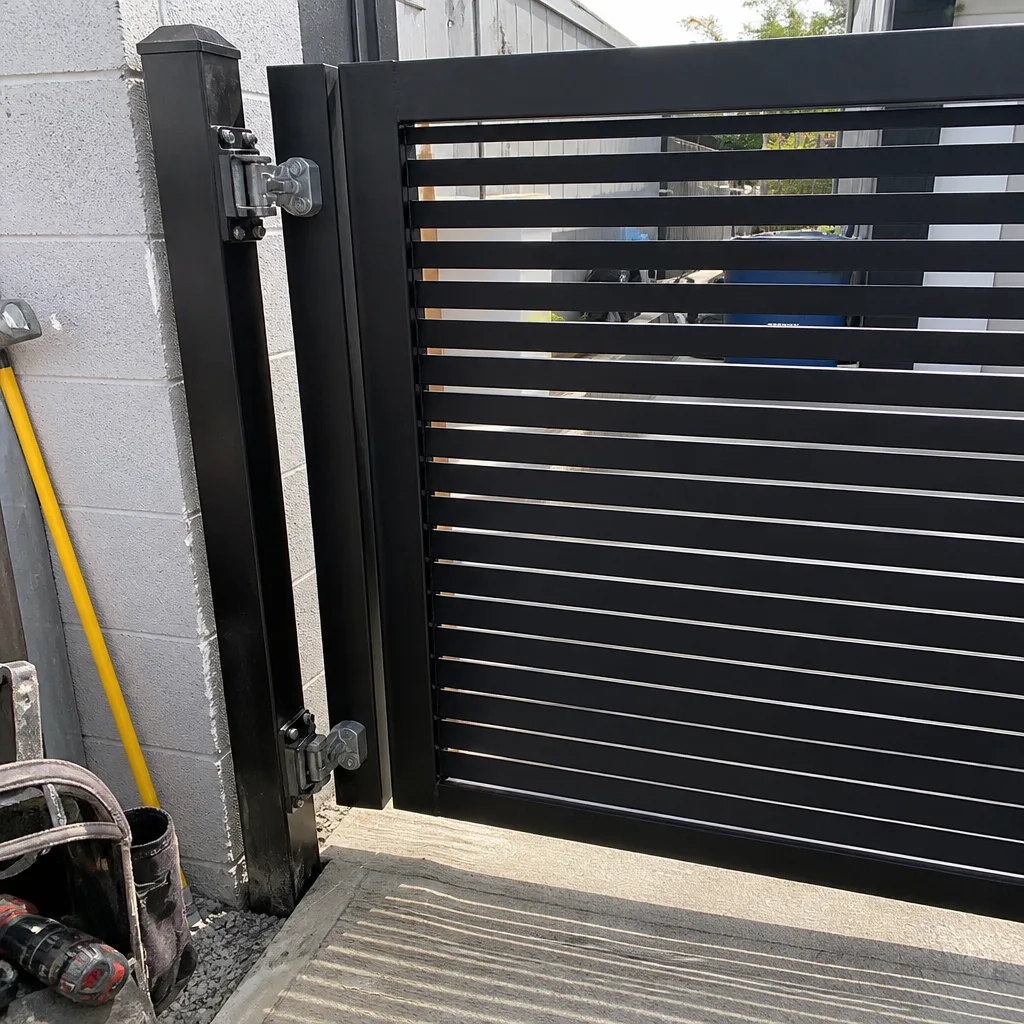 After
After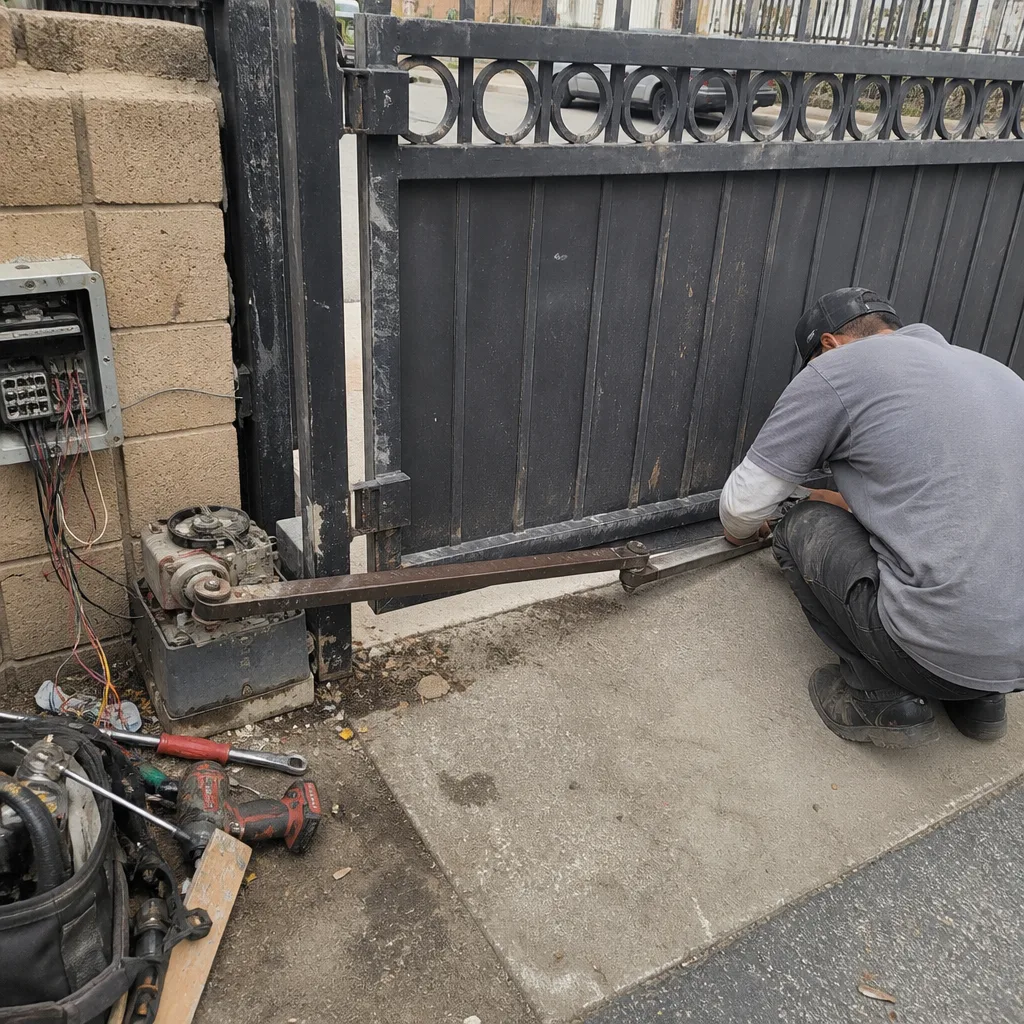 Before
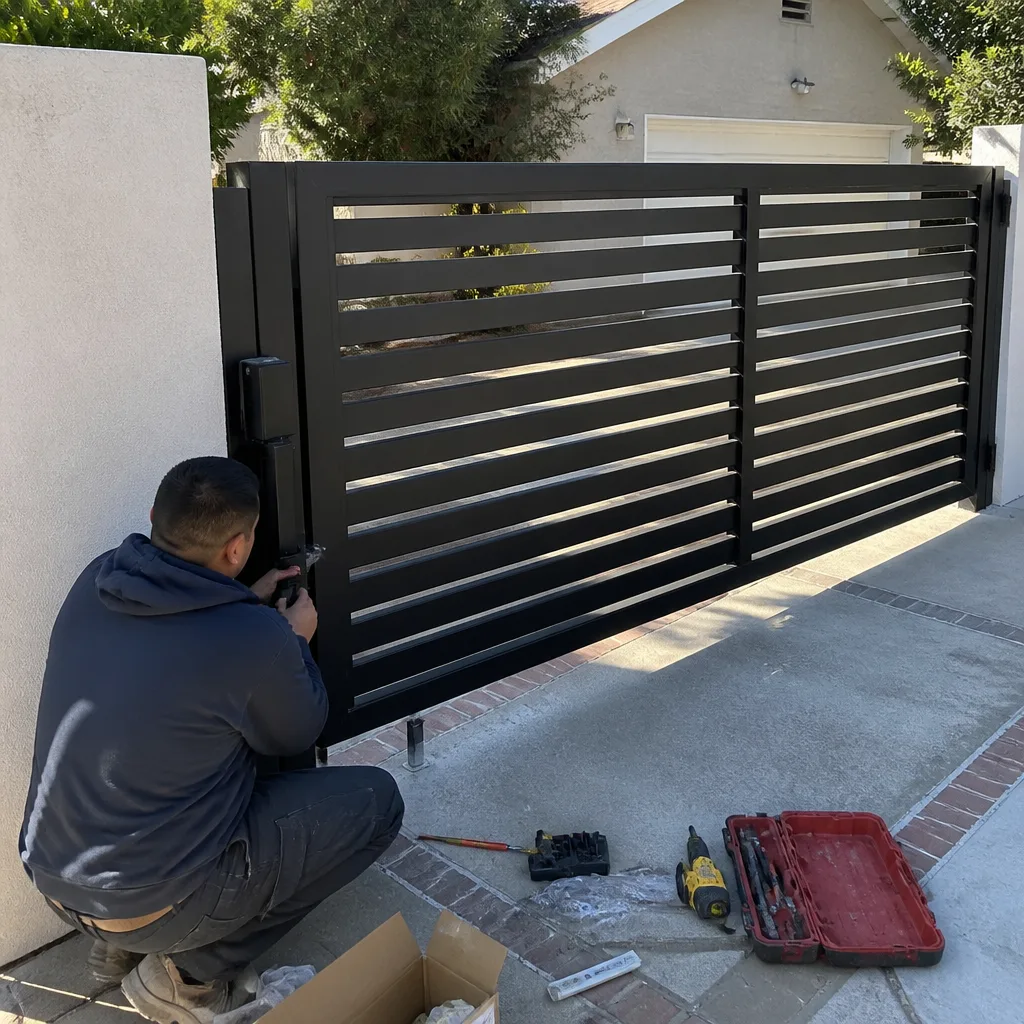 After
After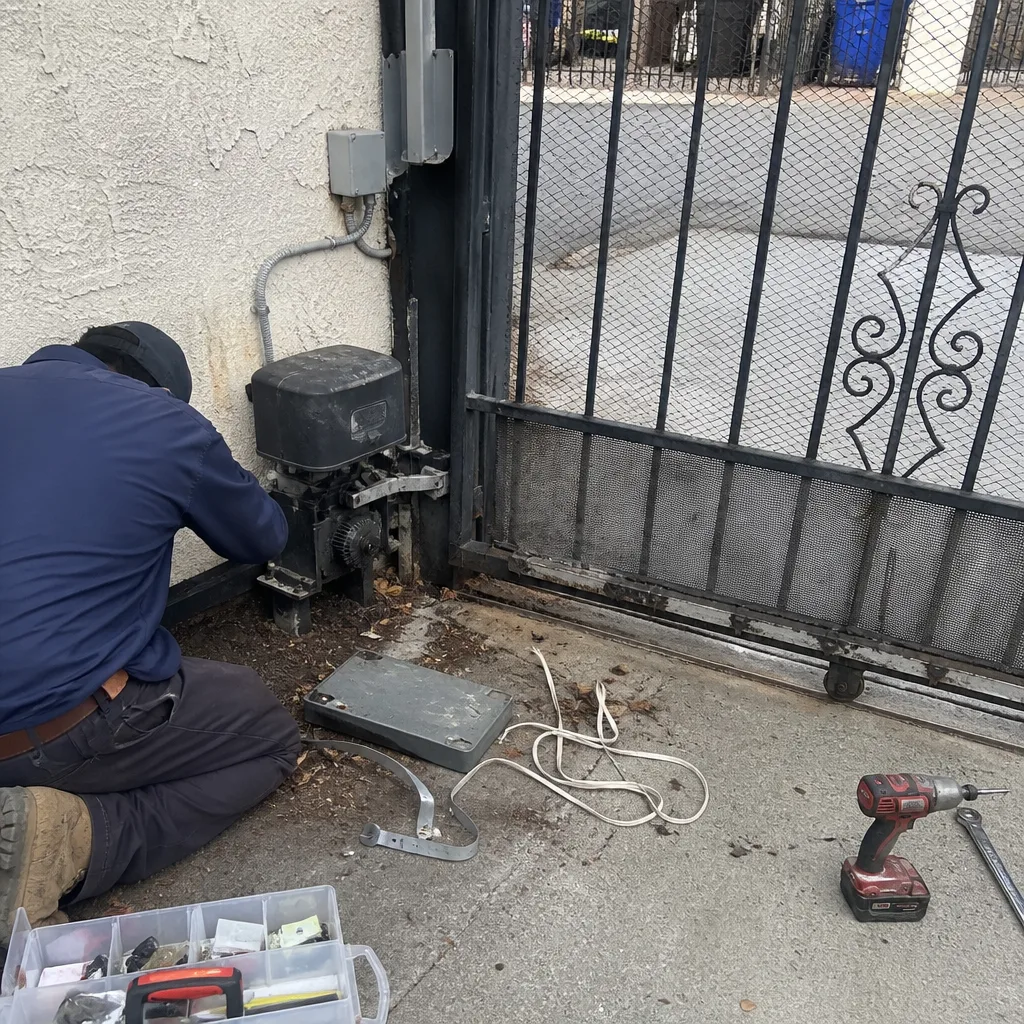 Before
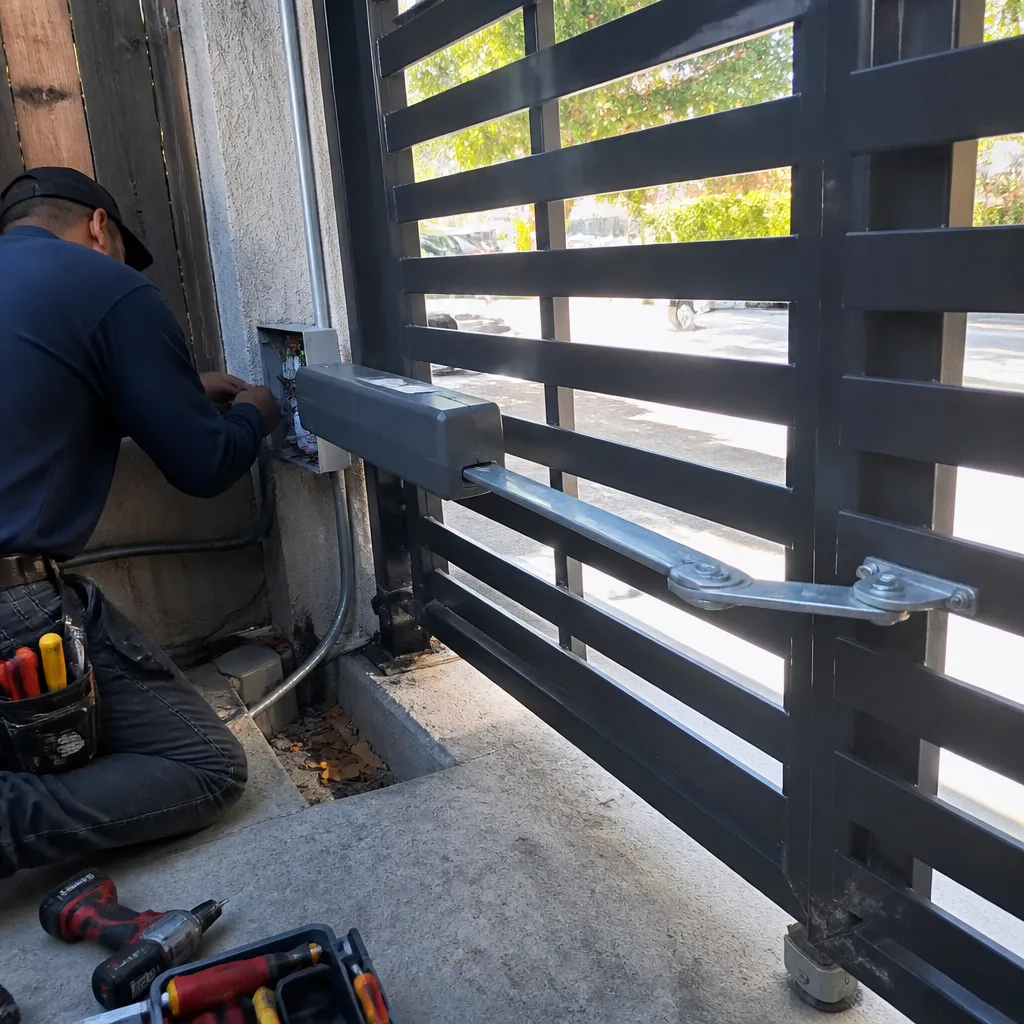 After
AfterThe Complete Guide to Gate Repair in Los Angeles
Most gate repair guides read like they were written in Ohio. They tell you to lubricate hinges and check the batteries, as if a gate in Encino behaves the same as a gate in Cleveland. It doesn’t. Los Angeles gates fail for reasons that don’t exist anywhere else: salt air that drifts 20 miles inland from the Pacific, concrete that shifts after every minor tremor, and utility easements that surprise homeowners mid-repair. This guide explains what actually goes wrong with gates in Los Angeles, what it costs to fix them, and how to avoid paying for our Gate Repair services twice.
Quick Answer
Gate repair in Los Angeles typically costs $180 to $480 for common mechanical and electrical fixes, with gate opener repairs running $250 to $850 depending on the brand and the part that failed. Most repairs take one to two hours on site, though parts availability can extend the job by a few days. The fastest way to get an accurate price is a free estimate from a gate specialist who works on your specific opener brand.
Table of Contents
- Why LA Gates Fail Differently Than Anywhere Else
- Salt Air Corrosion: The Invisible Enemy 20 Miles Inland
- Seismic Post Shift: How Minor Tremors Misalign Your Gate
- The HOA Approval Trap: Warranties and LA Neighborhood Rules
- Brand-Specific Failure Patterns in LA’s Climate Zones
- How to Read a Repair Estimate vs. a Replacement Pitch
- Repair or Replace: A Decision Framework for LA Homeowners
- Common Mistakes to Avoid
- When to Call a Professional
- Frequently Asked Questions
- The Bottom Line
Why LA Gates Fail Differently Than Anywhere Else
National gate repair guides assume a baseline: mild humidity, stable soil, occasional rain. Los Angeles breaks that assumption in three specific ways that we see on service calls every week across the city.
First, the marine layer. From Santa Monica to Pasadena, overnight fog carries microscopic salt particles inland. Those particles settle on exposed metal: gate hinges, track rollers, opener arms, chain drives. The result is corrosion that progresses two to three times faster than the national average. A hinge that would last a decade in Ohio might seize up in six years in Culver City or West LA.
Second, the ground moves. Southern California experiences hundreds of tiny seismic events annually, most too small to feel. But even a magnitude 2.5 tremor shifts soil and concrete slabs by fractions of an inch. Over five years, those fractions add up. Gate posts that were perfectly plumb at installation gradually lean. A leaning post means a gate that drags, latches poorly, or binds against the opener motor.
Third, above-ground utility lines. Los Angeles has some of the strictest setback and easement rules in the country, and older neighborhoods like Hancock Park, Silver Lake, and the San Fernando Valley have utility lines that don’t always match current maps. We’ve seen homeowners start a gate post replacement only to discover a gas line or electrical conduit three inches from the old footing. That discovery can add days and thousands of dollars to a job, through no fault of the homeowner.
If you’re researching gate repair in Los Angeles, the first question isn’t “what’s broken.” It’s “what caused it?” Answer that correctly, and you won’t pay for the same fix twice.
Salt Air Corrosion: The Invisible Enemy 20 Miles Inland
You don’t need an ocean view to have a salt corrosion problem. The marine layer pushes inland overnight, often reaching the 405 corridor, Sherman Oaks, and even parts of the Valley on heavy fog days. We’ve replaced gate hinges in North Hollywood that looked like they’d been submerged in seawater for a year. They hadn’t. They’d just spent six years in LA fog.
Corrosion hits three areas hardest:
- Gate hinges and pivot points: Salt accelerates rust on exposed steel. A corroded hinge binds, forcing the opener motor to work harder. That extra strain shortens motor life and eventually burns out the capacitor or the gearbox.
- Opener circuit boards: Salt air doesn’t just attack visible metal. It gets inside the opener housing through vents and seams, coating circuit board contacts with a fine corrosive film. We see intermittent opener failures in coastal areas that are almost always board corrosion.
- Chain drives and track rollers: Chains rust from the outside in, developing stiff links that jump sprockets. Rollers pit and grind instead of rolling. The gate gets jerkier and noisier until something snaps.
What can you do? Rinse exposed metal parts with fresh water two or three times a year if you live within 10 miles of the coast. Inspect hinge points for rust bloom every six months. And if your gate starts moving slower or sounding different, don’t wait for total failure. A $40 hinge replacement today beats a $600 opener motor replacement next spring.
Seismic Post Shift: How Minor Tremors Misalign Your Gate
Every Los Angeles homeowner knows about earthquakes. What most don’t realize is that the small ones, the magnitude 2s and 3s that happen constantly, do more cumulative damage to gates than the rare big one. They don’t knock anything over. They just shift the ground under your gate posts a fraction of an inch at a time.
Here’s the sequence we see repeatedly:
- Year one to two: The gate opens and closes fine. The post shift is invisible to the eye.
- Year three to four: The gate starts dragging slightly on the latch side. The opener motor works harder but still functions. You might notice a new hum or a slower cycle time.
- Year five to six: The gate won’t close fully, or the latch doesn’t catch. The opener’s limit switch, the small sensor that tells the gate when to stop, gets confused because the gate now travels a slightly different path than it did at installation.
- Year seven plus: The opener motor or gearbox fails from years of overwork. The repair bill is now significant because you’re fixing both the alignment and the opener.
The fix for post shift isn’t always replacing the post. Often it’s a shim and re-alignment job that takes under two hours. The key is catching it early. If your gate scrapes the ground, latches inconsistently, or has a wider gap at the top than the bottom of the post, the alignment has already drifted. Call a gate specialist before the opener pays the price.
The HOA Approval Trap: Warranties and LA Neighborhood Rules
Los Angeles has thousands of HOAs, many of which govern gate appearance, height, materials, and even the specific brand of opener you can install. We’ve seen homeowners void their opener warranty, and more critically, their HOA architectural approval, by swapping a gate motor without filing the required paperwork first.
Here’s how the trap works:
- Your gate breaks. You call a repair company. They install a new opener. It works. You pay and move on.
- The HOA notices the change. Many LA HOAs require pre-approval for any gate alteration, including opener replacements. If the new opener looks different, sits differently on the post, or has a different control box, it can trigger a violation notice.
- The manufacturer warranty on the opener is conditional. Some opener brands, including LiftMaster and FAAC, explicitly state that installations must comply with local HOA or municipal codes. A non-approved installation can become a warranty dispute later.
Before you authorize any gate opener replacement, check your HOA’s architectural guidelines. If they require approval for gate hardware changes, get it in writing first. A one-week delay for approval is far better than an unapproved installation you have to reverse. Calder Gate Repair has worked in LA neighborhoods from Sherman Oaks to Woodland Hills where HOA rules vary block by block, and we always ask about HOA requirements before quoting a replacement.
Brand-Specific Failure Patterns in LA’s Climate Zones
Not all gate openers fail the same way. After years of repairing gates across Los Angeles, we’ve mapped distinct failure patterns by brand and climate zone. If you own one of these openers, this is what to watch for.
LiftMaster in the Valley Heat
LiftMaster openers are workhorses, but Valley summers push their thermal limits. We see capacitor failures in July and August when temperatures hit the high 90s and 100s. The capacitor, the component that gives the motor its starting jolt, degrades faster in sustained heat. Symptom: the opener hums but the gate doesn’t move. The fix is usually a $150 to $250 capacitor replacement, far cheaper than a new motor.
FAAC in Coastal Humidity
FAAC hydraulic openers are popular in hillside LA neighborhoods, but the hydraulic fluid and seals don’t love the coastal humidity cycle. We see more seal weeping and fluid degradation in Santa Monica, Pacific Palisades, and Marina del Rey than in inland areas. Symptom: the gate moves slower than usual, especially on cold mornings. The fix often involves new seals and fluid, typically $200 to $350.
Mighty Mule and Ghost Controls in DIY Installations
Mighty Mule and Ghost Controls are the two most common DIY-installed openers in Los Angeles. The failure pattern isn’t brand-specific so much as installation-specific: undersized wiring, poorly seated post brackets, and control boards fried by voltage surges from LA’s occasionally volatile grid. We regularly find these openers installed with wire gauge too thin for the run length from the house to the gate. Symptom: the opener works intermittently or loses connection to the remote. The fix often requires rewiring and reconfiguring the control board, usually $200 to $400.
How to Read a Repair Estimate vs. a Replacement Pitch
Gate contractors in Los Angeles know that a broken gate is an emotional moment for a homeowner. Your property feels exposed. Your routine is disrupted. Some contractors exploit that urgency by framing every repair as a “necessary upgrade” to a full system replacement. Here’s the language to watch for.
Repair language: “Replace limit switch,” “rewire control board,” “re-align gate posts,” “replace hinge bearings,” “new capacitor.” These are specific, itemized fixes. They typically cost $80 to $350 in labor plus parts.
Replacement pitch language: “This opener is obsolete,” “you’ll save money in the long run by upgrading,” “we can’t guarantee a repair on equipment this old,” “this is a safety issue.” These phrases push you toward a $1,500 to $4,000 full replacement when a $300 repair might solve the problem for years.
Ask three questions when you hear a replacement pitch:
- “What exactly failed?” A specific diagnosis builds trust. Vague language doesn’t.
- “What would a repair cost, even if it only lasts two years?” Run the math. A $350 repair that buys two years is cheaper than a $3,000 replacement that lasts ten.
- “Can I see the failed part?” A reputable tech will show you the burned capacitor, the seized hinge, the corroded board. If they won’t, get a second opinion.
At Calder Gate Repair, we put the price in writing before any work starts. The number on the invoice is the number agreed to at the door. No surprise line items. No pressure upselling.
Repair or Replace: A Decision Framework for LA Homeowners
Some gates are worth fixing. Some aren’t. Here’s the framework we use with homeowners across Los Angeles when they ask us whether to repair or replace.
Repair makes sense when:
- The gate itself, meaning the frame, posts, and hinges, is structurally sound.
- The opener is under 10 years old and the failure is a single component: capacitor, limit switch, circuit board, remote receiver.
- The repair cost is under 40% of a comparable replacement.
- The gate is a standard size and style, meaning parts are readily available.
Replacement makes sense when:
- The posts have shifted so far that re-alignment would require new footings.
- The gate frame is rusted through in multiple places, not just surface rust.
- The opener is over 15 years old and replacement parts are discontinued.
- The gate no longer meets current LA safety code requirements for entrapment sensors and reversing mechanisms.
For a deeper look at opener-specific issues, see our gate opener repair in Los Angeles page. If your gate has electrical components that aren’t working, including keypads, intercoms, or sensors, our electric gate repair in Los Angeles page covers those systems in detail.
Common Mistakes to Avoid
- Ignoring a slow gate. A gate that’s moving slower than it used to is telling you the motor is struggling. Wait long enough and that $40 hinge becomes a $600 opener replacement. Fix the cause early.
- Using WD-40 on everything. WD-40 is a solvent, not a long-term lubricant. It strips existing grease and makes metal parts run dry. Use white lithium grease on hinges and rollers, not penetrating oil.
- Replacing the opener without checking the gate alignment. If the gate is binding, a new opener will just burn out faster than the old one did. The alignment problem has to be fixed first.
- Skipping HOA approval in a rush to fix the gate. We covered this above, but it bears repeating. A quick unapproved opener swap in an HOA-managed neighborhood can cost you a violation notice and a voided warranty.
- Buying the cheapest opener online and self-installing. The opener is only as good as its installation. Undersized wiring, poor bracket mounting, and skipped safety sensors are the three most common DIY failures we see in LA.
- Not testing the safety reverse after any repair. Every gate opener has a reversing mechanism that detects an obstruction and stops the gate. After any repair, test it with a rolled-up towel. If it doesn’t reverse, the gate is a safety hazard.
When to Call a Professional
Some gate problems are safe to diagnose yourself: a visible rust spot, a remote with a dead battery, a track with debris in it. Other problems aren’t. If your gate opener’s capacitor is swollen or leaking, the capacitor holds an electrical charge that can cause a serious shock even when the opener is unplugged. If a gate post has shifted enough that the gate binds, the gate can fall if you remove the wrong bolt. High-tension gate springs and heavy cantilevered gates deserve professional attention, not a weekend DIY attempt.
Calder Gate Repair offers free estimates in Los Angeles. Call (903) 417-0793 and a live person will answer, 24 hours a day. We’ll give you an honest diagnosis, a written price before any work starts, and a plan for getting your gate working again. If you’re just starting your research, visit our Calder Gate Repair home page to learn more about how we work.
Frequently Asked Questions
Most gate repairs in Los Angeles run $180 to $480 for common mechanical fixes like hinge replacement, post re-alignment, and limit switch adjustments. Gate opener repairs cost more, typically $250 to $850, because they involve electrical components and brand-specific parts. The exact price depends on your opener brand, the failed component, and parts availability. Call (903) 417-0793 for a free estimate with a written price before any work starts.
In most cases, yes. Calder Gate Repair keeps common parts for LiftMaster, FAAC, Mighty Mule, and Elite openers on our trucks, so many repairs are completed same-day. If we need to order a part, we’ll tell you the lead time before we leave your property. Call (903) 417-0793 and a live person will book your appointment and give you a trackable arrival time.
Our technicians are factory-familiar with nine major gate opener brands: LiftMaster, FAAC, BFT, Linear, Viking, Ghost Controls, DoorKing, Elite, and Mighty Mule. If you have a different brand, call us anyway. We’ll check parts availability and let you know immediately whether we can help.
It depends on your HOA’s architectural guidelines. Simple repairs like hinge replacement or limit switch adjustment rarely require approval. Opener replacements, gate style changes, or post work often do. Check your HOA documents before authorizing any work that changes the appearance or equipment on your gate, and get approval in writing if required.
In most cases, repairing an existing gate does not require a city permit. Replacing a gate post with new footings, installing a new gate on a new foundation, or relocating a gate can trigger permit requirements depending on your location and the scope of work. A qualified gate contractor can tell you if your specific job needs a permit.
Intermittent operation is usually one of three things: a corroded circuit board, a failing capacitor, or a bad connection at the control box. In coastal LA areas, circuit board corrosion from salt air is the most common culprit. In the Valley, it’s often heat-related capacitor failure. A technician can diagnose which one it is in about 20 minutes. Call (903) 417-0793 to schedule a free estimate.
The Bottom Line
Gate repair in Los Angeles is a city-specific problem with a city-specific solution. Salt air accelerates corrosion, seismic activity misaligns posts, and HOA rules complicate repairs that would be simple elsewhere. The key is catching problems early and working with a repair partner who knows LA’s climate zones, brand failure patterns, and neighborhood rules; for more guides & resources, visit our blog. Calder Gate Repair brings that local knowledge to every job, with a written price before work starts, a written guarantee on every repair, and a free second visit if the fix fails within 365 days. Call (903) 417-0793 today for a straight answer on your gate.
Written by Nico Alvarez, Owner at Calder Gate Repair, serving Los Angeles since 2009.