
Last updated October 9, 2026
Free on-site gate assessment - hinges, posts, and your LiftMaster or Nice gate operator checked before anything is quoted
The assessment is free and the quote is the invoice.
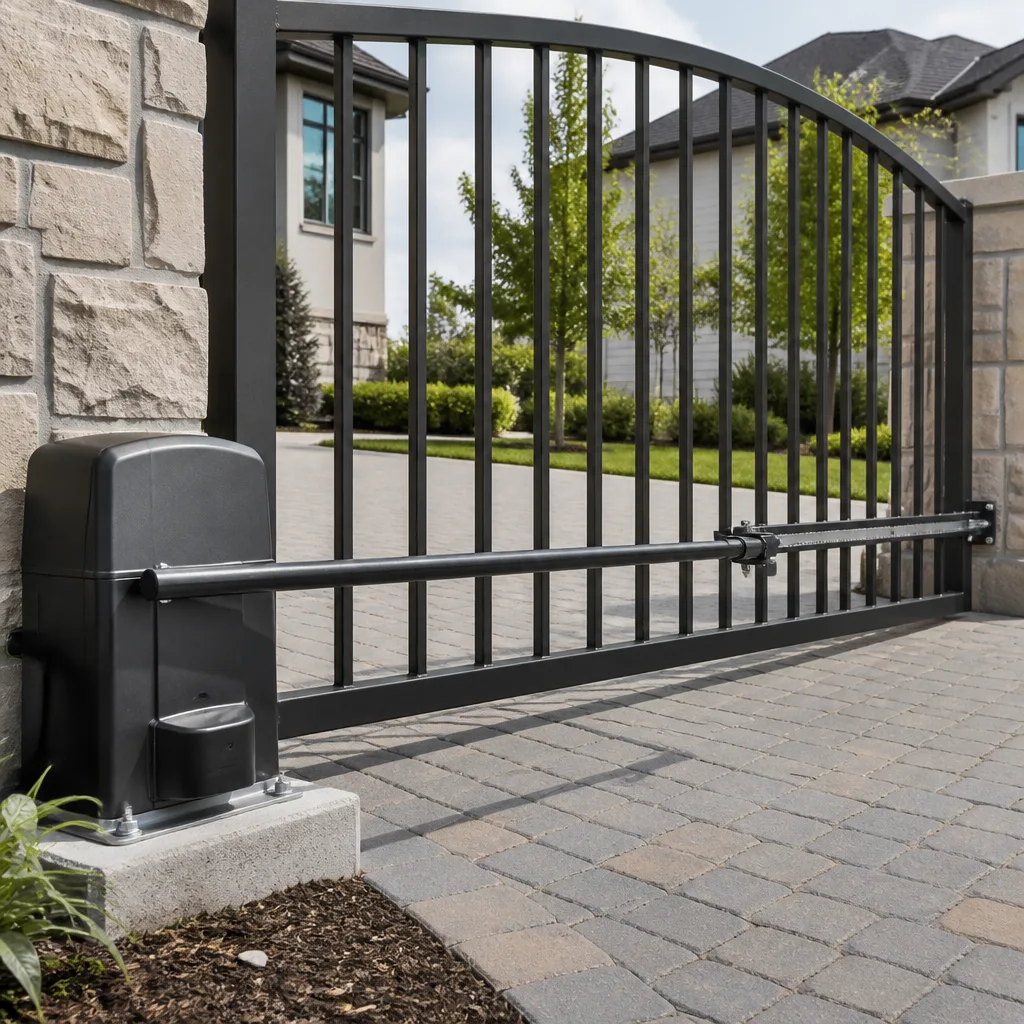
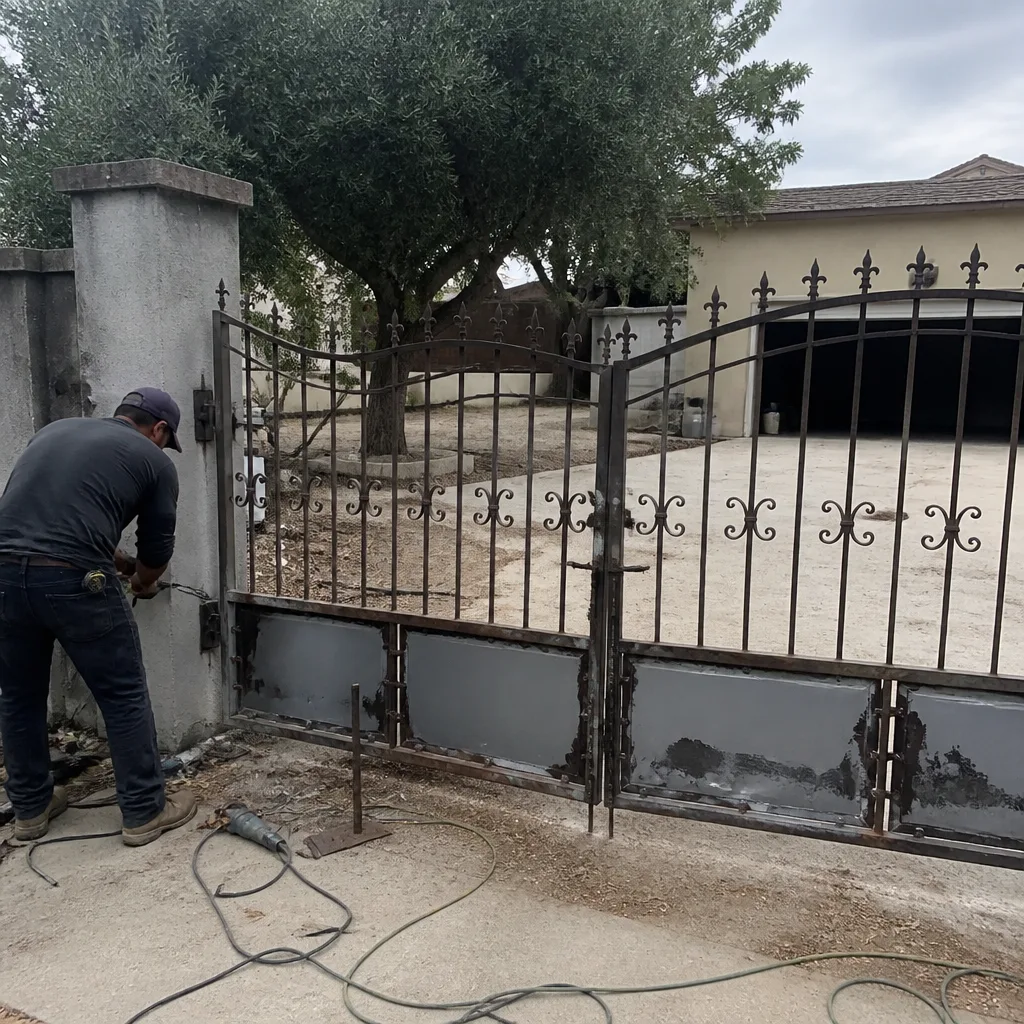 Before
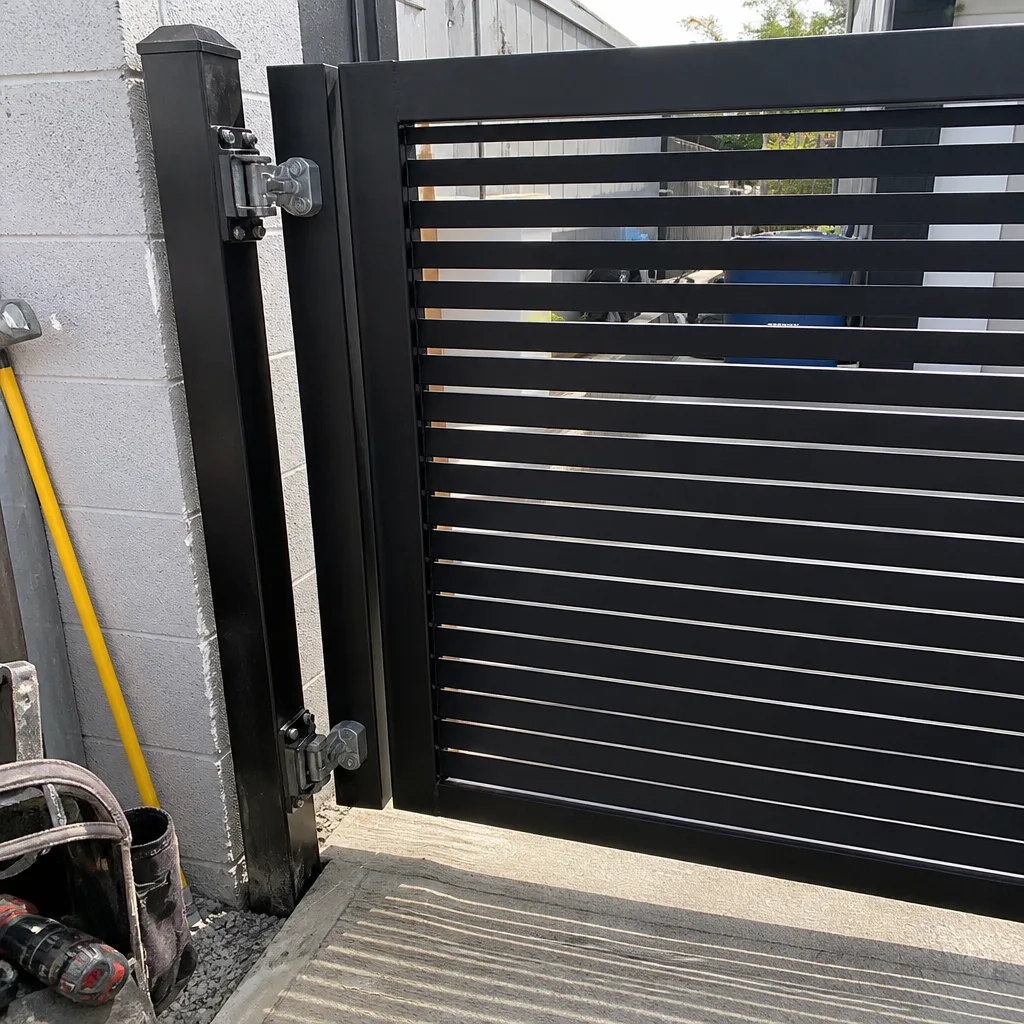 After
After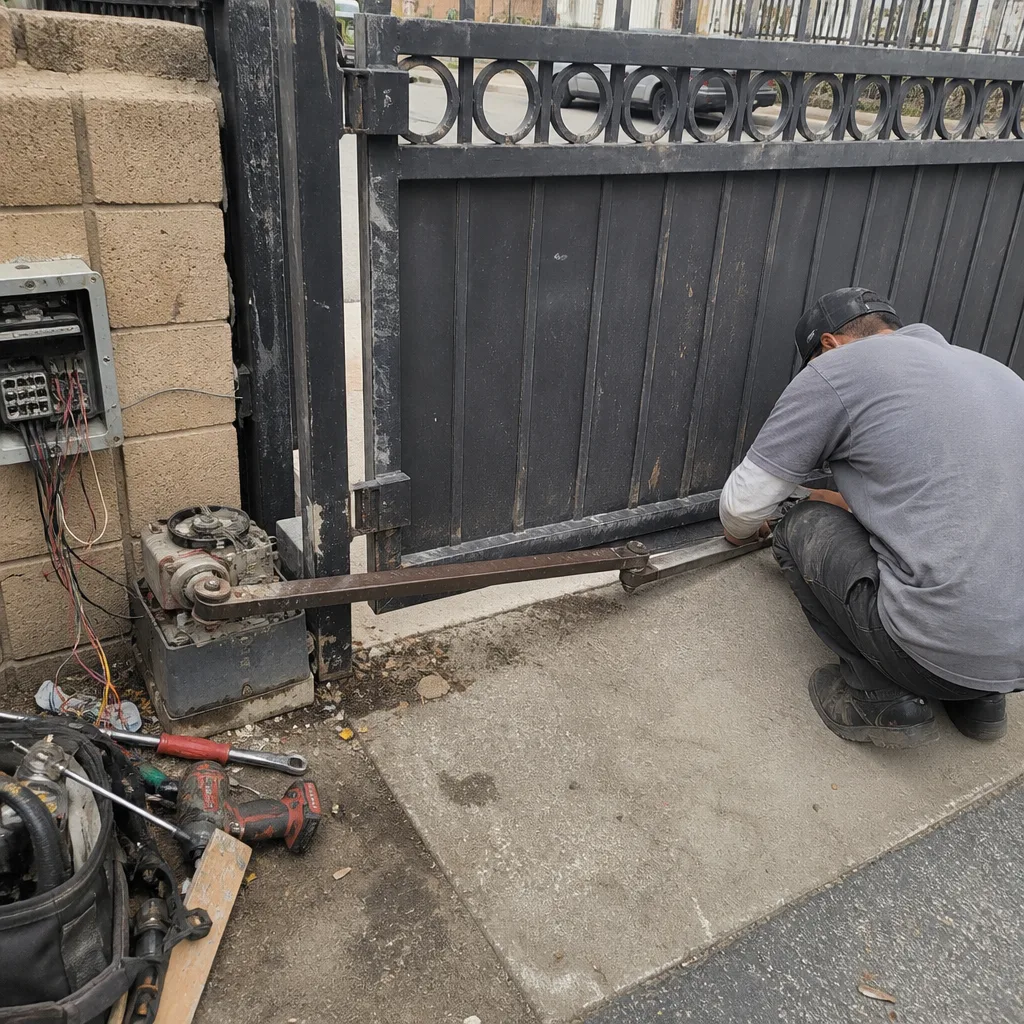 Before
 After
After Before
 After
AfterHow Long Does Gate Opener Repair Take? Timelines and What to Expect
Technicians who claim every Gate Opener Repair takes “1-2 hours” are either only counting wrench time or they’ve never worked on a LiftMaster RSL12 with a burned secondary relay. The honest answer is that gate opener repair timelines split into three buckets: fast fixes under an hour, standard board-and-sensor work that runs two to four hours, and motor or wiring jobs that can stretch across a full day or into a second visit. Los Angeles homeowners deal with a particular mix of these because our climate wears out solar-charged battery systems faster than inland markets, and our older hillside properties often have gates installed decades ago with wiring that was never meant to last this long. What you’ll learn here is how to predict which bucket your repair lands in before the technician even arrives.
Quick Answer
Most gate opener repairs take between 45 minutes and 4 hours on-site, with remote and sensor issues at the fast end, control board replacements in the middle, and motor or wiring failures at the slow end. The real variable is parts availability: if your opener’s specific board or motor is on the truck, you’re done same-day. If it has to be ordered, expect a 2-3 day wait even though the actual install only takes an hour.
Table of Contents
- Fast Fixes: Remote, Receiver, and Sensor Repairs (45-90 Minutes)
- Control Board and Relay Repairs: The 2-4 Hour Middle Ground
- Motor Replacement: When the Job Takes Half a Day or More
- The Truck Stock Question: What Actually Determines Your Wait Time
- Why Multi-Brand Expertise Compresses Diagnosis Time
- What Legitimately Extends a Gate Opener Repair in Los Angeles
- Three Scheduling Questions That Get You an Honest Timeline
- Common Mistakes to Avoid
- When to Call a Professional
- Frequently Asked Questions
Fast Fixes: Remote, Receiver, and Sensor Repairs (45-90 Minutes)
When your gate opener stops responding to remotes or keypads, the fix is usually quick. A technician who knows the brand can typically diagnose and resolve a receiver board failure, antenna issue, or remote programming problem in under an hour. Sensor misalignment, photo-eye obstructions, and limit switch adjustments fall into the same category. A limit switch is the small sensor that tells the gate when to stop at open or closed, and when one drifts out of position, the gate either stops short or overtravels and reverses. That adjustment typically takes 10 to 20 minutes on most brands.
Here’s a realistic breakdown of fast-track repairs:
- Remote programming or replacement: 15-30 minutes, including testing from multiple distances
- Photo-eye realignment or cleaning: 20-45 minutes
- Limit switch adjustment or replacement: 30-60 minutes
- Keypad reprogramming or battery replacement: 20-40 minutes
- Antenna extension or receiver board swap: 45-90 minutes
Los Angeles-specific note: many hillside properties in areas like Silver Lake and Mount Washington have gates at the bottom of long driveways, which means remotes get used from farther away than the manufacturer intended. We regularly see receiver sensitivity issues on these lots that turn out to be antenna placement problems, not electronic failures. Those are usually fixable in one visit.
Control Board and Relay Repairs: The 2-4 Hour Middle Ground
Control board failures are the most common mid-length repair we handle. The control board is the circuit board inside the opener housing that receives signals from remotes, keypads, and sensors, then tells the motor what to do. When one component on that board fails, a relay for example, the whole system can act dead even though the motor is perfectly fine.
A board-level repair in Los Angeles typically works like this:
- Diagnosis (30-45 minutes): The technician tests power input, checks for visible burn marks on relays, and confirms whether the issue is the board or a downstream component
- Board access and removal (20-30 minutes): Opening the housing, disconnecting wiring, and photographing the existing connections so reinstallation is exact
- Replacement or component-level repair (30-90 minutes): Swapping in a new board or replacing the failed relay directly, depending on part availability
- Testing and reprogramming (20-30 minutes): Reprogramming all remotes and keypads, testing safety sensors, and cycling the gate five to ten times
Ghost Controls and Linear boards are relatively straightforward to swap, while Viking and DoorKing boards often require matching revision numbers because the same model had different board versions over the years. A technician who doesn’t know your brand well might spend 45 minutes just figuring out which board version you have.
Motor Replacement: When the Job Takes Half a Day or More
Motor replacement is the heavy repair. When the gate opener motor burns out, which in Los Angeles often happens on older homes where the gate is heavier than the opener was rated for, the work involves removing the operator arm, disconnecting power, extracting the motor assembly, and rebuilding the drivetrain. On a straightforward swing gate with good access, motor replacement typically runs three to five hours. On a sliding gate with a chain drive, add an hour. On a gate that hasn’t been serviced in years, add another hour for freeing seized bolts and cleaning corroded connections.
Critical point: motor replacement is where the truck stock question hits hardest. Some companies carry only universal motors or none at all. If your opener needs a brand-specific motor, a Linear actuator motor for example, and the company has to order it, your “half-day job” becomes a one-hour install that happens three days after the diagnostic visit. At Calder Gate Repair, we carry motors and boards for the brands common across Los Angeles, but we’ll tell you straight up during the diagnostic call whether same-day completion is realistic or whether we need to schedule a return trip. For more detail on what to expect, see our guide on How Long Does Gate Repair Take? Timelines and What to Expect.
The Truck Stock Question: What Actually Determines Your Wait Time
Here’s the inflection point most homeowners never think to ask about: does the company carry your specific board, motor, or sensor on the truck, or do they order parts per job? This single variable determines whether your repair is a 45-minute fix or a three-day event. And it’s a completely reasonable question to ask before booking.
Why the gap is so dramatic:
- Truck stock companies diagnose the problem, walk to the vehicle, grab the part, and finish the repair in one visit. The repair takes as long as the labor takes.
- Order-per-job companies diagnose, write up the part number, submit an order, and return days later. The repair takes the labor time plus the shipping time.
In Los Angeles, with its traffic patterns and tightly scheduled households, that difference matters even more. A homeowner in Pasadena or Sherman Oaks doesn’t want to take two separate afternoons off for what should have been one visit. Before you book any gate opener repair, ask this exact question: “Do you stock parts for my brand on the truck, or are you ordering after diagnosis?” A company with genuine parts depth will answer without hesitation. A company that hedges just told you everything you need to know.
Why Multi-Brand Expertise Compresses Diagnosis Time
Diagnosis is the invisible clock running on every repair. A technician who works on one or two brands spends the first hour figuring out how your system is wired. A technician who works across LiftMaster, FAAC, BFT, Linear, Viking, Ghost Controls, DoorKing, Elite, and Mighty Mule daily knows the architecture before opening the housing. That experience cuts diagnosis from an hour down to minutes, and it means the total repair timeline shrinks by the full value of that saved hour.
Here’s a concrete example. A Viking gate opener uses a different limit switch configuration than a DoorKing. A technician who mostly services residential LiftMaster units, then shows up to a Viking job, is going to open the housing, study the wiring, and probably make a service call or two. The repair isn’t harder. The diagnosis is longer because everything is unfamiliar. In our experience across Los Angeles, brand familiarity is the single biggest time-compressor after parts inventory. When you ask a company about their experience, don’t ask “do you fix gate openers?” Ask “how often do you work on my specific brand?” The answer tells you how long your job will actually take. For help vetting contractors, read our guide on How to Hire a Gate Repair Contractor in Los Angeles: A Step-by-Step Guide.
What Legitimately Extends a Gate Opener Repair in Los Angeles
Not every delay is a sign of incompetence. Some jobs are legitimately longer because of conditions on the ground or inside the gate. Los Angeles has a few recurring culprits we see week after week.
Conduit wiring failures: Many older Los Angeles homes built between the 1940s and 1970s ran gate wiring through rigid metal conduit that has since corroded. If the failure is in the wire inside the conduit rather than at a connection point, the repair involves pulling new wire through existing runs. That’s a slower process. It can add one to three hours depending on the run length and how many elbows are in the conduit path.
Gate posts out of alignment: A gate opener that’s straining against a misaligned gate burns out motors and strips gears. Replacing the motor without resetting the post means the new motor fails the same way. Post resetting involves excavating around the base, re-plumbing the post, and re-pouring or shimming. That’s a legitimate add-on that can extend a motor job by several hours or push part of the work to a second visit.
Concurrent mechanical damage: Sometimes the opener failed because the gate itself is damaged, a hinge is seized, or the track is bent on a sliding gate. The opener repair is quick, but the mechanical repair underneath it is not. A good technician will tell you upfront: “I can replace this board in 90 minutes, but your gate hinge is seized, and if we don’t fix that, the new board will fail the same way.” That conversation is the difference between a repair that lasts and a repair that revisits.
None of these are excuses. They’re real conditions that affect real timelines. An honest company explains them before starting, with a written price for both the immediate fix and the underlying issue.
Three Scheduling Questions That Get You an Honest Timeline
Before you book any gate opener repair in Los Angeles, ask these three questions. They’ll force an honest timeline out of any company, and a good company will welcome them.
- “Do you carry parts for my specific brand on the truck, or will this require a second visit after ordering?” This is the single biggest timeline variable. If they can’t answer it, expect a vague quote and a longer wait.
- “How many of these specific openers do you service in a typical month?” Brand-specific frequency tells you whether the diagnosis will be fast or whether you’re paying hourly for their learning curve. You want a technician who sees your brand weekly, not annually.
- “Will I get a written price before you start, and what happens if the job runs longer than expected?” A company with a written-price policy care about the price being agreed upfront. Calder Gate Repair puts the price in writing before any work starts, and the invoice matches that number, not a surprise figure based on how long the job happened to take.
Common Mistakes to Avoid
- Accepting “it’ll be 1-2 hours” without asking the parts question. That estimate usually means wrench time only. If they don’t have your board, your one-hour repair becomes a one-hour repair that happens next Tuesday.
- Replacing the opener before diagnosing the failure. We’ve seen homeowners in Los Angeles replace entire opener systems when the actual problem was a $45 limit switch. Always get a diagnosis first.
- Ignoring the mechanical condition of the gate itself. A new opener on a misaligned gate is a repeat failure waiting to happen. Fix the underlying mechanical issue or you’ll be back here in eight months.
- Hiring a generalist who works on everything. Gate openers are a specialty. A handyman who also paints and does plumbing is not going to diagnose a Viking board as fast as a dedicated gate repair tech.
- Skipping the written price agreement. Any company that won’t put the price in writing before starting work is leaving room to revise upward mid-job. That’s not a gate repair policy, it’s a negotiation tactic.
- Waiting until the gate is completely dead to call. Grinding noises, slow operation, and intermittent remote failures are early warnings. Addressing them now prevents a motor replacement later.
When to Call a Professional
Gate openers involve high-tension springs, heavy moving metal, and live electrical circuits. If your opener is sparking, smoking, or seizing, don’t open the housing to investigate. A control board failure is not worth a trip to the urgent care. Call a technician if your gate is stuck open, stuck closed, making grinding noises, moving slower than it did a month ago, or if remotes and keypads stop working despite fresh batteries. Calder Gate Repair offers free estimates in Los Angeles. Call (903) 417-0793 and a live person will answer, 24 hours a day.
Frequently Asked Questions
Most gate opener repairs take 45 minutes to 4 hours on-site, depending on the failure type. Remote and sensor issues are fastest at under 90 minutes, control board replacements run two to four hours, and motor replacements can take half a day or more. The on-site time doesn’t include parts ordering if your specific part isn’t in stock.
Parts availability determines same-day service more than anything else. If your opener’s board, motor, or sensor is on the truck, same-day repair is realistic. If the part needs to be ordered, the install still takes under an hour but happens on a second visit. Call (903) 417-0793 and we’ll tell you straight up whether same-day is realistic for your brand.
Most gate opener repairs in Los Angeles run $180 to $650 before parts, depending on the failure type. Remote and sensor fixes are typically under $250, board replacements range $300 to $500 including the board, and full motor replacements run $500 to $900 or more. Every Calder Gate Repair job includes a written price before any work starts, and the invoice matches that number.
Sliding gate openers usually take longer to repair because the chain drive, track, and limit switches live in a tighter housing and require more disassembly to access. Swing gates are generally faster except when the hinge or post is also failing. In Los Angeles, heavy hillside swing gates add time because the opener works harder on every cycle.
For most repairs, you don’t need to be present the entire time. A technician needs access to the gate, power source, and usually a way to reach the control board. For troubleshooting that requires cycling the gate repeatedly, having someone home is helpful but not required. If the gate protects the only vehicle access to a property in the Hollywood Hills style, we’ll coordinate with you on timing.
Calder Gate Repair handles the low-voltage and standard 120V electrical work tied directly to the gate opener, including wiring, sensors, and control boards. If your Los Angeles property needs new conduit runs, sub-panel work, or dedicated circuit installation, we’ll tell you what’s in scope and what might require a licensed electrician, before we start any work. Call (903) 417-0793 for a free estimate.
Common Mistakes to Avoid
- Asking “how long does gate opener repair take” without asking “for my specific brand?” The answer varies wildly between a Ghost Controls remote fix and a Viking board replacement.
- Booking the first company that says same-day without verifying parts depth. Same-day claims mean nothing if the tech arrives, diagnoses, and has to order your board anyway.
- Treating all gate openers as interchangeable. A Linear opener and a DoorKing opener are different architectures. The technician’s familiarity with your specific brand is a real timeline factor.
- Delaying a repair because the gate still opens manually. Each week of grinding or straining worsens the underlying issue. A $200 sensor fix becomes an $800 motor replacement when ignored for months.
- Skipping the written estimate. Without a written price agreed before work starts, you’re trusting a verbal number. At Calder Gate Repair, the written price is the price you pay.
The Bottom Line
Gate opener repair timelines come down to three variables you can control: what failed, whether the company stocks parts for your brand, and whether the technician knows your specific opener architecture without a learning curve. Fast fixes finish in under 90 minutes. Board work runs two to four hours. Motor replacement stretches to half a day or longer, especially in Los Angeles where older hillside gates and corroded conduit add real time. Ask the parts question before you book. Ask about brand-specific experience. And get the price in writing before any bolt gets turned. Those three moves cut your wait time and eliminate surprise invoices. For more guides & resources, visit our blog.
Written by Nico Alvarez, Owner at Calder Gate Repair, serving Los Angeles since 2009.